Summary
Norway beat Brazil 2-1. Haaland scored twice. That was the match. But the night also left a technical signature: mobile data traffic up 23 percent nationally, SMS up 24 percent, a 10,000 percent spike at one base station near the Royal Palace, roughly 100,000 active phones in central Oslo, seismometers in Oslo and Bergen registering the celebration, and — this is the one worth putting in the title — a documented "toilet-rush" surge in water consumption during the half-time break. A country does not just watch a match like this. It leaves a mark on its own infrastructure.
I wrote the match itself up here: Norway Beat Brazil Again: Haaland Double Sends Norway Into World Cup History.
This is the other story. The one written not by journalists but by base stations, water pipes and seismometers.
The country became visible in the data
Telia, one of Norway's two largest mobile operators, reported that mobile data traffic across Norway rose 23 percent compared with the same time the previous week. SMS traffic rose 24 percent.
That is the ordinary shape of a national moment now — not just watched, but messaged, streamed, posted and refreshed, in millions of small network events happening at once.
Telia was not alone. Telenor — the other of the two — also reported historic pressure in the mobile network that night, with traffic 89 percent higher than on a normal Sunday. Norwegian betting activity showed the same pattern: Norsk Tipping said 350,000 customers placed bets during the round-of-16 match, making it their biggest single football match by customer count.
Different systems. Same national pulse.
Then there is the number that only makes sense once you picture Slottsplassen — the Palace Square, the open plaza in front of the Royal Palace in Oslo — at half past midnight. At the base station covering it, Telia recorded a 10,000 percent increase in data usage between 00:25 and 00:30, against the same five minutes the week before.
"The highest data usage came just after the final whistle."
— Georg Svendsen, head of infrastructure, Telia Norway, translated from Norwegian
Svendsen added that people on the Palace Square were almost certainly using their phones to share the moment with friends and family in real time. Not unusual behaviour. Just all of it, at once, in one place.
That is not sports traffic. That is a crowd turning itself into a network event.
Source: SOL / NTB: Økning på ti tusen prosent
The square outside the Royal Palace became a radio problem
More than 100,000 people were reported in central Oslo after the match, moving from Rådhusplassen (City Hall Square) up Karl Johans gate to the Royal Palace.
Oslo police put the scale in network terms rather than crowd terms:
"Around 100,000 mobile phones were active in the network in the area."
— Erik Sannes, Oslo Police District, translated from Norwegian
That is almost more telling than the crowd estimate. A celebration counted not in bodies but in active devices — filming, uploading, messaging, trying to reach a friend three metres away because the crowd is too dense to shout across.
Source: SOL / NTB: Økning på ti tusen prosent
The toilet-rush is real metadata
This is the part I actually wanted to write about, and it is the reason it is in the headline.
Dagbladet has documented a recurring "toilet-rush" effect in Oslo's water-consumption data during Norway's World Cup matches. Against Iraq earlier in the tournament, consumption jumped from around 1,760 to 2,660 litres per second at the first half-time break — a rise of more than 50 percent, arriving within minutes of the whistle.

People hold it in while the ball is live. Then a country flushes in unison.
"This is a known effect during major sporting events."
— Knut Bjelke, senior engineer, Oslo Water and Wastewater Agency, translated from Norwegian
Bjelke calls it, without any apparent irony, a toilet-rush.
In plain terms: a water utility does not know or care why demand spikes — only that it does, sharply, for a few minutes, at a predictable moment. What makes a football match visible in the pipes is synchronisation: tens of thousands of households pausing at the same break, then acting at the same moment, on the same fifteen-minute clock as the referee. The same mechanism shows up as a pause in taxi demand, a surge in water consumption, and, as it turns out, spikes in seismic readings. Different sensor, same crowd, same clock.
Source: Dagbladet: Norge stopper opp — Toalett-rush og taxi-pause under VM-kampene
The ground moved too
Jordskjelv.no reported that seismometers at the University of Oslo and the University of Bergen, part of the Norwegian National Seismic Network, registered clear signals from celebrations during the 2-1 win over Brazil.
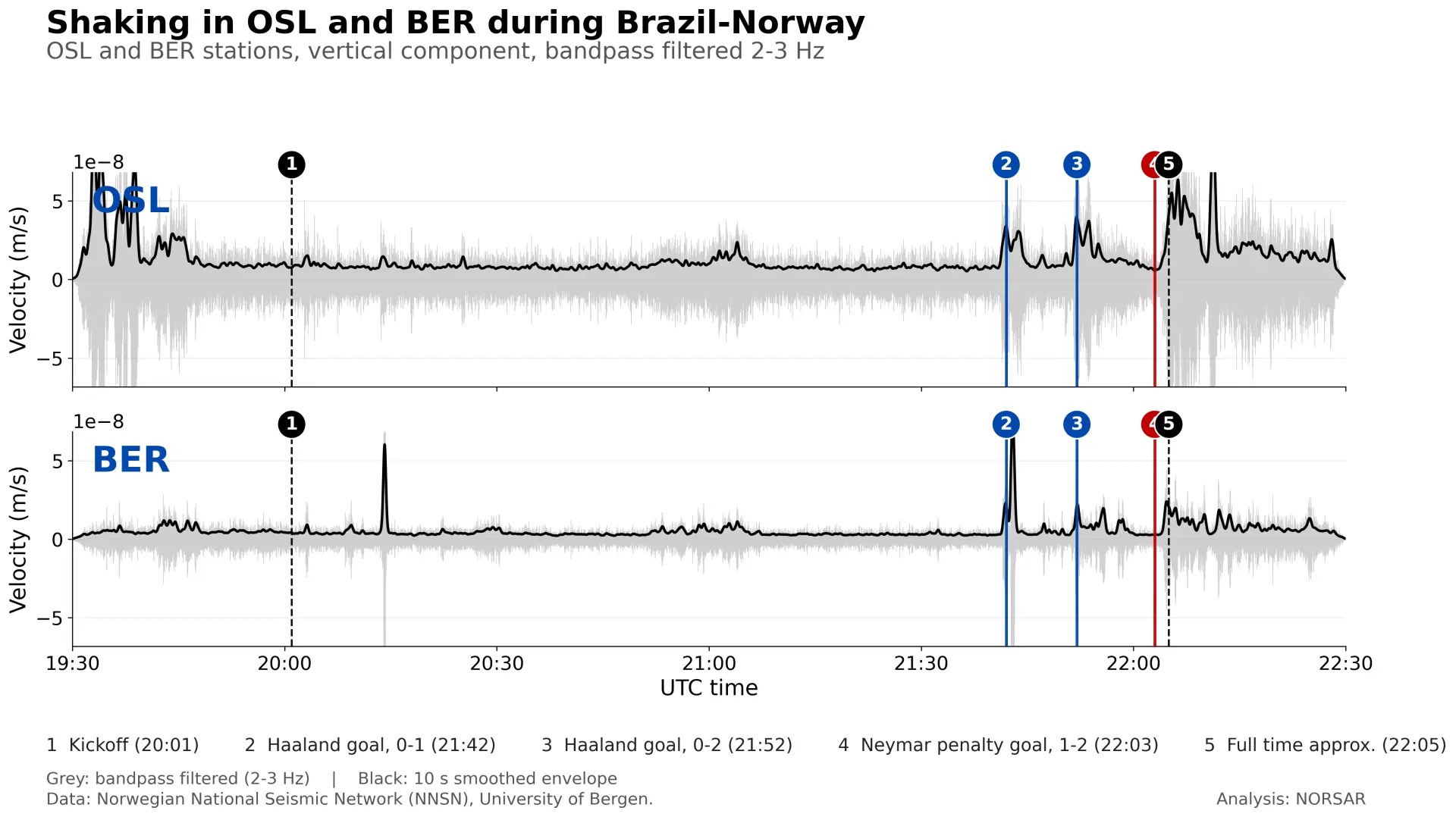
Not an earthquake. A crowd.
"Modern seismometers register far more than earthquakes."
— Jordskjelv.no / NORSAR, translated from Norwegian
Traffic, construction, concerts — and, this tournament, a country celebrating a World Cup knockout win over Brazil — all leave a trace, provided enough people move at once.
Norway scored. The country shook. That is not a metaphor. It is a seismograph reading.
It is also not the first time an Oslo tremor has said something about infrastructure rather than geology — I wrote in April about what an actual Oslo earthquake revealed about the city's hidden layers. This one was man-made, but the sensor still begins with the same basic fact: ground motion. The interpretation comes afterwards.
Source: Jordskjelv.no: Norges seier over Brasil fikk bakken til å riste
Bergen first. Then Oslo and Bergen. Then this.
The wider metadata pattern did not start with Brazil.
The water-pipe version was already visible earlier in the tournament, when Oslo's water consumption surged during a half-time break. The seismic version began in Bergen, where a university seismometer picked up the physical trace of Norwegian goal celebrations — Norway Came to Row. The Earth Noticed..
Then, after the win over Côte d'Ivoire, both Oslo and Bergen registered signals — and the largest one that night was not a goal at all, but the synchronised "ro, ro til seier" rowing celebration that followed full time, which I wrote up here: Norway Rowed, and Two Cities Shook on the Seismograph.
Brazil was the biggest match, the biggest crowd, the biggest release — and the data followed the same curve, one size larger.
Source: Jordskjelv.no: Norges seier over Brasil fikk bakken til å riste
The metadata started before kick-off
There was a quieter signal before the match, too: attention.
Norway had not met Brazil in a World Cup like this in 28 years. Dagbladet's pre-match reader polling showed real tactical anxiety building — thousands of readers wanted Ståle Solbakken to change the side that had started against Côte d'Ivoire, with Oscar Bobb in for Alexander Sørloth the most requested change.
"That right-wing position is important."
— Bernt Hulsker, football expert, Dagbladet, translated from Norwegian
Solbakken did not start with that change. At half-time he made it anyway — Bobb and Andreas Schjelderup came on together, and Schjelderup later assisted Haaland's first goal.
The crowd's instinct was not the whole answer. But it was not noise either. Call it attention metadata: thousands of people independently pointing at the same weak spot before a ball was kicked.
Source: Dagbladet: Nervene i helspenn — Vil gjøre drastisk grep
International parallels: Super Flushes and pop seismics
This infrastructure shadow is not unique to Norway; it is the universal signature of any massive, synchronized human event.
In the United States, utility companies have long tracked "The Super Flush" during the Super Bowl. During one famous final, the New York City Department of Environmental Protection recorded a dramatic drop in water usage while the game was live, followed by a massive, synchronized spike the moment the halftime show ended—equivalent to roughly 760,000 toilets flushing at the exact same time across the metropolitan area.
The phenomenon of human emotion registering as physical ground motion has its own international precedents too. In 2011, ecstatic Seattle Seahawks football fans jumping in celebration triggered vibrations equivalent to a minor magnitude 2.0 earthquake, famously dubbed the "Beast Quake." More recently, pop star Taylor Swift shattered that record during her Eras Tour in the same city, where 72,000 fans danced so perfectly in sync that seismologists registered a "Swift Quake" with a magnitude of 2.3.
Different countries, different stadiums, different cultures. But the engineering reality remains identical: when a population moves as one, the infrastructure has to carry the weight.
Norway beat Brazil 2-1. Then it generated a 10,000 percent mobile-data spike at one base station, sent SMS traffic up a quarter, flushed in a synchronised wave, and shook the ground hard enough for two universities to notice. Football gave Norway the moment. The metadata proved the country felt it.
Closing
None of these numbers identify a single person, and none of them need to. A 23 percent rise in data traffic, a 10,000 percent spike at one base station, a 50-percent half-time surge in water use, a seismic trace in two cities — this is metadata as social weather. It does not replace the football. It is the shadow the football casts across the infrastructure underneath it.
The phrase I keep coming back to is this: culture becomes load. When enough people do the same thing at the same moment, a shared feeling stops being abstract and turns into demand — on a mobile network, on a water main, on the ground itself. Ordinary traffic tells you how a system behaves on average. A night like this tells you what happens when a country moves as one.
Sources
- Norway Beat Brazil Again: Haaland Double Sends Norway Into World Cup History
- SOL / NTB: Økning på ti tusen prosent
- Jordskjelv.no / NORSAR: Norges seier over Brasil fikk bakken til å riste
- Dagbladet: Norge stopper opp — Toalett-rush og taxi-pause under VM-kampene
- Dagbladet: Nervene i helspenn — Vil gjøre drastisk grep
- Norway Came to Row. The Earth Noticed.
- Norway Rowed, and Two Cities Shook on the Seismograph
- What today's Oslo earthquake in Norway revealed about infrastructure
- The New York Times: Water Use Plummets During Super Bowl Halftime
- Pacific Northwest Seismic Network: The Seattle 'Beast Quake' and 'Swift Quake' Records