
When Europe Fell Silent
At precisely 01:00 BST on Saturday, 27 June 2026, a sound that had accompanied Europe for generations simply ceased to exist.
No alarm was raised.
No countdown appeared on television.
No crowds gathered beneath the red warning lights that crowned the transmitter masts at Droitwich.
Across Britain — and, under the right conditions, across much of Northern Europe — a radio carrier that had occupied the same place in the electromagnetic spectrum for nearly a century quietly vanished.
198 kilohertz was gone.
Almost nobody noticed.
That may be the most extraordinary part of this story — not because the transmitter was unimportant, but because it had become invisible. Like a lighthouse whose beam has swept across the horizon for so long that sailors stop thinking about the mechanism behind it, BBC Long Wave had faded into the background of everyday life. It was simply there — night after night, decade after decade — carrying news, the Shipping Forecast, Test Match Special, national moments of grief and celebration, and, long before any of those, something even more fundamental: reassurance that the signal was still alive.
One of the people who heard the silence had built his first long-wave receiver at the age of fourteen, and his most recent at seventy-one. Even the simplest technology, he wrote, could still pull a usable signal out of the air — try doing that with a DAB set. He was one of dozens who wrote, in the weeks before the end, to say what the loss would mean. An end of an era, more than one of them called it. They meant a private one — a lifetime spent with a band of the spectrum almost no one else thought about. They did not yet know they were describing something larger.
Its disappearance marked more than the retirement of a broadcasting service. It marked the quiet end of one of Europe’s last great monuments of analogue communications engineering.
That sentence deserves careful qualification.
This is not an argument against the Internet. Nor is it an exercise in technological nostalgia. Modern communications are, by almost every measurable standard, superior. Fibre-optic networks move incomparably greater volumes of information. Satellites connect continents. Mobile networks place instant communication into the hands of billions of people. Cloud infrastructure distributes services across regions and oceans with a level of resilience that engineers a century ago could scarcely have imagined.
The modern world did not replace long-wave radio because it failed. It replaced it because it built something vastly more capable.
Yet capability is not the same as character.
Every technology is designed to answer a particular question.
Modern digital infrastructure asks:
How do we continue operating when individual components fail?
The engineers who designed Europe’s great long-wave transmitters were answering a different question entirely.
How do we continue communicating when the world around us no longer functions as expected?
It is an older question. A darker one — born not from convenience but from catastrophe.
To understand why that distinction matters, it helps to leave 2026 behind for a moment and return to another Europe — one still haunted by the memory of the First World War, watching political extremism spread across borders, and beginning to realise that radio was no longer merely an invention.
It had become national infrastructure.
The transmitters rising above the English countryside were never simply taller radio towers. They were statements of intent.
Built with enormous power reserves, hardened engineering, independent generating capability and extraordinary geographical reach, they embodied a philosophy that now feels strangely unfamiliar: if everything else failed, the signal should endure.
For decades, it did.
It crossed mountains.
It followed coastlines.
It ignored frontiers.
It travelled into fishing boats on the North Sea, isolated farms, merchant vessels in the Atlantic and, during Europe’s darkest years, into occupied homes where families listened behind drawn curtains with the volume turned almost to silence.
To them, these were not merely radio broadcasts. They were proof that another Europe still existed beyond censorship, occupation and fear.
Almost ninety years later, the carrier disappeared in silence.
The remarkable thing is not that the BBC eventually switched it off.
Given the economics, the ageing infrastructure and the collapse in audience, that decision was probably inevitable.
The remarkable thing is how easily we accepted the disappearance of a communications system deliberately engineered to remain operational through war, national emergency and the failure of almost everything around it.
Perhaps that tells us as much about twenty-first century Europe as the transmitter ever told us about the twentieth.
The Signal
To modern eyes, long wave almost defies intuition.
We are used to communication systems that become powerful by becoming dense. More fibre. More masts. More routers. More satellites. More exchanges. More data centres. More paths through the network.
Long wave belonged to a different engineering world. It became powerful by becoming immense.
The principle was simple enough to explain, and difficult enough to build that only states, national broadcasters and militaries tended to do it at full scale. A transmitter generated a radio signal at a very low frequency. The wavelength was enormous. The antenna system had to be enormous too. The power levels were extraordinary by broadcasting standards. But once the system worked, the reward was equally extraordinary: a signal that could follow the curvature of the Earth and reach far beyond the horizon.
Not by magic, but by physics.
At higher frequencies, radio behaves more like light. FM and DAB are mostly line-of-sight technologies. They are excellent within their intended coverage areas, but the Earth gets in the way. Hills matter. Valleys matter. Buildings matter. Distance matters quickly.
Long wave is different.
A vertically polarised low-frequency signal can propagate as a ground wave. It travels along the surface of the Earth, losing energy as it goes, but not stopping at the visible horizon. Over conductive ground, and especially over seawater, it can travel remarkable distances. The sea, in radio terms, is not empty space. It is a favourable medium.
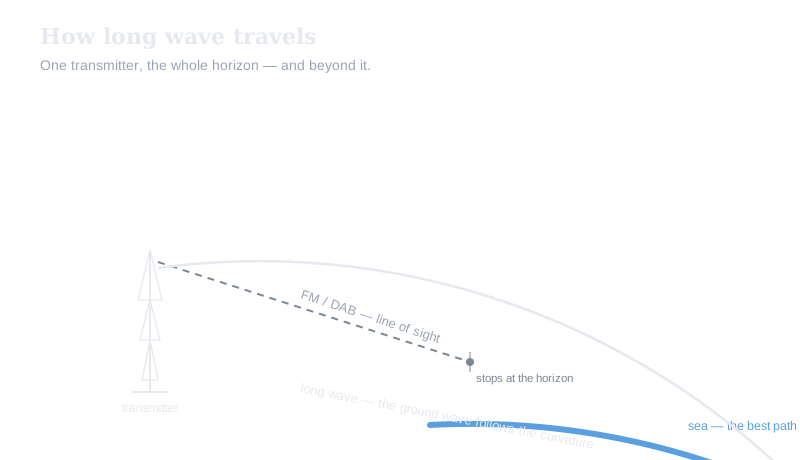
The sea is a favourable medium
That is why the Shipping Forecast and long wave belonged together so naturally.
The signal did not merely serve people on land who liked the sound of sea areas being read aloud late at night. It reached people who were actually out there — beyond the reach of ordinary domestic broadcasting, in weather, darkness and uncertainty, where radio was not atmosphere or nostalgia but information.
Libby Purves, broadcaster and lifelong offshore sailor, put it plainly when she wrote that long wave reached “far out to sea, beyond Fastnet and along the edge of Iceland,” and recalled midnight news being received south of the Azores. The poetry of the Shipping Forecast was real, but so was its utility.
For those at sea, the litany was not quaint. It was practical.
Viking. North Utsire. South Utsire. Forties. Cromarty. Forth. Tyne. Dogger. Fisher. German Bight.
For millions on land, those names became part of Britain’s cultural memory — strange, calming, almost liturgical. For sailors, fishermen and offshore workers, they were something else: an interface between human vulnerability and a hostile environment.
Long wave made that interface national.
It allowed one voice to reach an entire country, and in favourable conditions well beyond it, without asking whether the listener had a subscription, a mobile signal, a functioning broadband line, a working DNS resolver or access to an app store. The receiver could be cheap. The batteries could last. The antenna could be crude. The intelligence was not in the device. It was in the transmitter.
That design choice matters.
The intelligence is in the transmitter
Most modern communications systems push complexity outward. A smartphone is a marvel of computation, cryptography, radio engineering, software updates, authentication, app ecosystems and network negotiation. It is astonishing. It is also dependent on a long chain of other systems continuing to behave.
Long wave moved complexity in the opposite direction.
It concentrated cost, power and engineering skill into the broadcast site. The listener needed very little. In an age before universal electricity, before reliable telephony, before satellites, before digital networks, that was not a limitation. It was the point.
At Droitwich, this philosophy became steel, copper, glass and power.
The site in Worcestershire was not a modest radio installation. It was an industrial statement. Two 700-foot steel lattice masts rose above the countryside. A vast aerial system hung between them. Beneath the soil lay a buried network of conductors, the invisible half of the antenna, binding the transmitter electrically to the earth it used as part of its reach. Inside the station, high-power transmitter units converted electrical energy into a national signal.
The scale was difficult to hide. It was meant to be.
Droitwich was built in the 1930s, when Europe still believed in physical infrastructure as a public act. Railways, power stations, telephone exchanges, broadcast towers — these were not just utilities. They were declarations that the state could organise matter, labour and knowledge into systems larger than private life.
The station reportedly cost around £200,000 to build in 1934 — roughly tens of millions in today’s money. It occupied more than fifty acres. Its masts weighed hundreds of tons. Its power plant included diesel generators, fuel storage and cooling systems. For years, it could operate independently of the public grid.
This is the part that feels almost alien now.
The transmitter was not designed merely to be efficient when conditions were normal. It was designed to continue when conditions were not.
That is a very different kind of engineering.
In modern infrastructure, we often speak about redundancy. We duplicate components. We distribute workloads. We fail over between regions. We design systems so that the loss of one server, one rack, one fibre route or one data centre does not bring the service down.
This is good engineering. It is also engineering based on a particular assumption: that the surrounding world remains mostly intact.
Power is available somewhere. Networks route around damage. Spare capacity exists. Operators can coordinate. Supply chains can deliver. Control planes remain reachable. Credentials still validate. Time still synchronises. The world may be degraded, but it is not fundamentally hostile.
Long wave was designed with a harsher imagination.
Its question was not only: what if a component fails?
Its question was closer to: what if the ordinary world stops being available?
What if the telephone network is unreliable?
What if newspapers are censored?
What if roads are blocked?
What if the population is dispersed, frightened or occupied?
What if receiving information becomes dangerous?
What if the listener has almost nothing — but still has a radio?
A long-wave transmitter could not solve those problems, but it could continue speaking into them. That made it more than a broadcast technology: it made it a form of persistence.
The Builders
The first mistake is to imagine that the men who built Droitwich were building a radio station.
Technically, of course, they were. Politically, they were building something closer to a national nervous system.
By the early 1930s, broadcasting had moved beyond novelty. The first fragile years of wireless enthusiasm — headphones, crystal sets, amateurs listening for distant signals through static — had given way to something larger and more institutional. Radio had become domestic. It entered kitchens and parlours. It set the rhythm of evenings. It carried music, weather, news, speeches, sport and ceremony.
Radio becomes power
But governments had noticed something else. Radio could reach a country at once.
It did not require roads to be open. It did not require newspapers to be printed. It did not require every town to have a telephone exchange capable of carrying public information. It did not ask the listener to be literate, mobile, wealthy or near a city.
A voice could leave one building and arrive, almost instantly, in millions of homes. That was new.
And once states understood it, radio stopped being merely a medium. It became power.
Britain’s answer was shaped by a particular institutional imagination. The BBC, under John Reith, did not think of broadcasting as a collection of local entertainments. It thought nationally. Broadcasting was to be organised, disciplined and public in character. The phrase later attached to Reith — to inform, educate and entertain — is more complicated in its documentary origins than popular memory suggests, but the philosophy was clear enough. Broadcasting was not just a market. It was a public utility.
That mattered: a commercial broadcaster could ask where the audience was profitable; a national broadcaster had to ask where the country was.
The difference led directly to engineering.
The early BBC network was a patchwork of regional transmitters. Useful, but limited. Medium wave could serve cities and regions, but national coverage required either many stations or one signal large enough to make geography less important. Long wave offered the second possibility. Its wavelength was inconveniently large, its antennas expensive, its transmitters hungry, but it could do something strategically seductive: it could cover a nation from one high-power site.
That is why Daventry mattered first, and Droitwich mattered more.
Daventry, which opened in 1925, gave the BBC its first true long-wave national service. Droitwich, opened in 1934, turned the idea into something larger, more modern and more permanent. It inherited the ambition of national broadcasting and expressed it at industrial scale.
The location was chosen carefully. Droitwich, in Worcestershire, sits close to the population centre of England and Wales. A transmitter placed there could reach outward in all directions, avoiding the coastal imbalance that would have wasted signal into the sea or left parts of the country weakly served. The site near Wychbold was bought in 1933. Foundations began that year. By 1934, two 700-foot steel masts stood above the countryside.
It is difficult, now, to understand what that meant. The masts were not scenery. They were among the most visible pieces of national infrastructure in Britain. Each was a work of dangerous manual construction, raised by riggers operating hundreds of feet above the ground at a height for which there was little domestic precedent. There was a strike over danger money. There were arguments over safety belts. There was at least one fatal accident during the work. The language of infrastructure often hides the bodies that build it. Droitwich should not.
To raise a long-wave transmitter was to organise risk: steel, concrete, copper, diesel, glass, water, labour, land, spectrum.
The transmitter hall was the visible centre of the machine, but much of Droitwich’s power was underground. A long-wave antenna is not only what rises into the air. It is also what is buried beneath the field: radial conductors, earth systems and carefully engineered electrical contact with the ground. The Earth itself becomes part of the apparatus.
This is one of the reasons low-frequency engineering feels so different from the digital systems we now inhabit.
A cloud region is abstract to most people. Its physical reality is hidden inside anonymous buildings, behind access controls, fibre trenches, cooling systems and contractual layers. A long-wave station could not hide in the same way. It was geography made technical. You could point to it from a road and say: that is where the country speaks from.
Droitwich was expensive.
One contemporary local account puts the capital cost at around £200,000 in 1934, roughly tens of millions in today’s money. That figure should be treated with some caution; it appears to rest on a later historian’s summary rather than a clean aggregate figure in the surviving BBC booklet. But even if the exact number shifts, the order of magnitude is clear. This was not a hobbyist’s mast. It was a national investment in reach.
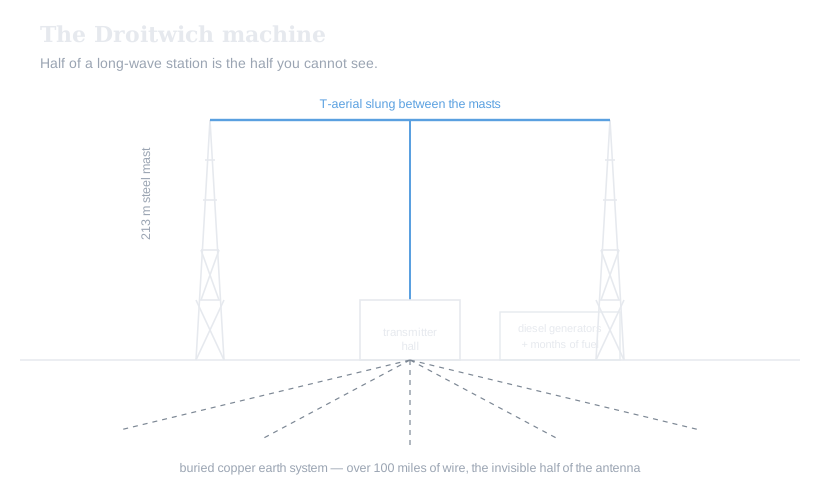
The station carried its own power systems. Four English Electric marine diesel engines, each driving a large alternator, gave it independent generating capability. Fuel storage offered months of operation. Cooling systems handled the heat of high-power radio transmission. The site was not initially dependent on the ordinary grid in the way a modern listener might assume.
Again, the design reveals the fear.
It was not enough that the station work on a normal day.
It had to work when normality failed.
That is the difference between infrastructure built for convenience and infrastructure built for continuity.
The British were not alone in thinking this way. Across interwar Europe, long wave was being treated as a national instrument. Germany developed Deutschlandsender as a national long-wave service. France invested in powerful transmitters. The Soviet Union operated enormous radio infrastructure. In 1933, the Lucerne Plan divided European long-wave and medium-wave frequencies among states — a diplomatic act that makes sense only when spectrum itself has become a strategic resource.
Treaties are not written for toys; they are written for power, borders, armies, trade, water, airspace, cables and frequencies.
Radio had joined that list.
There is something revealing in the fact that the Lucerne Plan allocated frequencies with the same seriousness that states allocate territory. A wavelength is not land, but in the twentieth century it became a kind of invisible territory: a place from which a state could speak, and which other states were expected not to occupy.
The transmitter, then, was not only an engineering object; it was a geopolitical one.
It belonged to an age in which physical infrastructure carried public authority. A state that could build railways, power stations, telephone exchanges and transmitters was a state that could act at scale. Droitwich was not merely a mast in a field. It was a proof of competence.
The proof was audible.
The place became the signal
In September 1934, the station began carrying the BBC’s National Programme. In October, it formally opened. The frequency was 200 kilohertz, corresponding to a wavelength of 1,500 metres. Later, in 1988, it shifted to 198 kilohertz to align with the international 9 kHz channel spacing used in the region. For most listeners, the number mattered less than the name on the dial.
Droitwich.
For decades, that word appeared on radio sets.
Not BBC.
Not Radio 4.
Droitwich.
The place became the signal.
That is another difference between old infrastructure and new. Much of today’s digital infrastructure is designed to make place disappear. The cloud abstracts geography. Content delivery networks hide distance. Applications float between regions. A user rarely knows where a service is actually running, and when the abstraction works, that ignorance is a feature.
Long wave did the opposite. It made geography part of trust.
You knew the signal came from somewhere. A mast. A station. A hill. A field. A room full of valves and engineers. It was centralised, physical and almost stubbornly material.
That centralisation is easy to criticise.
One transmitter can be a single point of failure. One mast can fall. One site can be bombed. One building can burn. Distributed systems exist for good reasons.
But centralisation also has an overlooked virtue: it can be hardened.
It is easier to defend, power, staff and understand one great machine than a million tiny dependencies spread across a continent. A long-wave transmitter is not invulnerable. Nothing is. But its failure modes are legible. You can see the mast. You can store the fuel. You can train the engineers. You can test the generator. You can guard the gate.
Modern infrastructure often fails in ways that are less visible: a certificate expires, a routing policy propagates, a fibre route is cut in a place few citizens can name, a mobile mast runs for a few hours after a blackout and then dies while the map still shows coverage.
This does not make modern infrastructure weak. It makes it complex.
The interwar engineers did not have that complexity available to them. They could not build a packet-switched network, a satellite constellation or a multi-region cloud platform. They built with the tools they had: radio frequency, steel, copper, valves, diesel engines and site discipline.
But because their tools were physical, their assumptions were physical too. How far can the signal travel? How much power can we generate, how much fuel can we store, how tall can the mast stand, how much copper must be buried? How many engineers must know the machine — and how long can it keep speaking? Those are not obsolete questions. They are merely ones modern societies have become less used to asking, and in the 1930s they were about to become urgent.
The Voice
The urgency arrived faster than almost anyone expected.
In 1934, Droitwich had been a monument to national broadcasting. Within five years, it belonged to a continent at war.
Radio was no longer only a public service. It was a front.
When armies crossed borders and governments collapsed, newspapers could be censored, telephone lines monitored, postal systems controlled and public speech made dangerous. But radio did something harder to contain. It crossed the same borders the armies crossed. It entered homes without permission. It could be jammed, punished, denounced and feared, but it could not easily be made to respect occupation.
This is where the BBC came in — not because it was flawless. It was a wartime institution, operating under state pressure, censorship and the imperatives of national survival. It had its own myths and limitations. But in a Europe being forced to listen to occupiers, collaborators and propaganda ministries, the existence of another voice was itself a fact of political importance.
People did not listen only for information; they listened for continuity.
A bulletin from London could confirm that the world had not been reduced to the map printed by the occupier. It suggested that governments still existed, that armies still fought, that exiled kings had not vanished, that languages suppressed in public could still be spoken aloud somewhere beyond reach.
The BBC became, in this sense, an acoustic geography of free Europe. France heard London. Belgium heard London. The Netherlands heard London. Poland heard London. Norway heard London. Denmark, uniquely, could listen without the same formal illegality that marked much of occupied Europe, but there too the phrase “Her er London” carried a weight ordinary broadcasting had never possessed.
A continent learned to recognise the sound of a distant capital as proof that its own nations had not entirely disappeared.
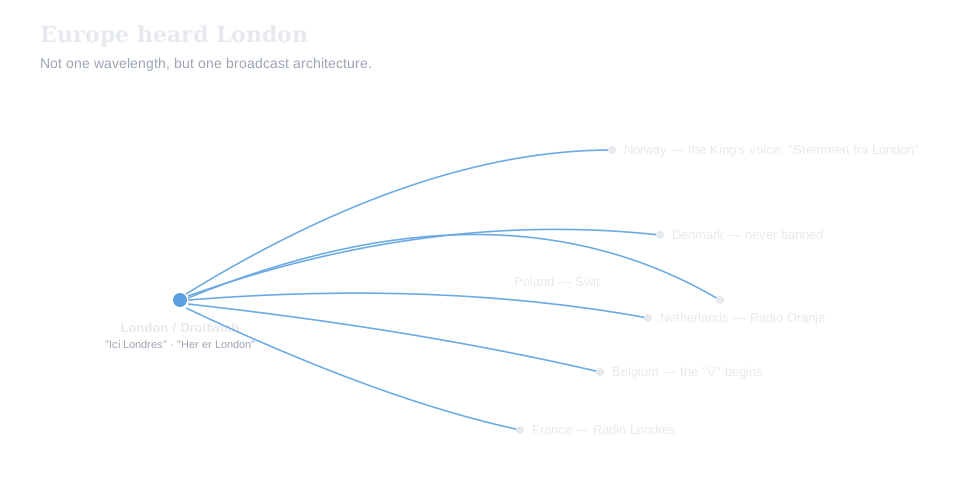
This is difficult to understand from inside a communications environment defined by abundance. Today, almost any event appears instantly in too many places: news sites, messaging apps, satellite feeds, social media, livestreams, emergency alerts, government pages, rumours, bots, screenshots and reposts. The problem is often not silence but excess.
In occupied Europe, the problem was imposed silence.
Poetry as operational instruction
And into that silence came voices.
Some were formal. Some were coded. Some were absurd by design.
“Jean has a long moustache.”
“There is a fire at the insurance agency.”
Such messages, broadcast by the BBC’s French service, were not intended to make sense to ordinary listeners. That was the point. They were personal messages to resistance networks: signals to prepare, to move, to sabotage, to wait. They turned the domestic radio set into a clandestine interface between London and occupied territory.
The most famous of these coded moments came before D-Day, when lines from Paul Verlaine’s “Chanson d’automne” were broadcast in two parts.
Les sanglots longs des violons de l’automne.
The long sobs of the violins of autumn.
The popular version of the story has grown too smooth over time. It was not a single cinematic announcement to all of France that the invasion would begin in twenty-four hours. Its meaning was more specific, tied to particular resistance networks and sabotage plans. But the myth survives because it captures something true even when it simplifies the mechanism: Europe was listening to poetry as operational instruction.
The occupiers understood the danger.
They jammed. They threatened. They confiscated. They punished listeners. In some countries, merely possessing a radio became suspect; sharing news heard from London could become an act of resistance. The ordinary domestic receiver — a piece of furniture in peacetime — acquired the moral charge of contraband.
This is where the story of long wave stops being British. It becomes European. And nowhere is that clearer than in Norway.
Norway: the voice from London
Germany invaded Norway on 9 April 1940. Within days, the Norwegian state was in flight. King Haakon VII, the government and the Storting moved from Oslo to Hamar and then to Elverum. German demands followed. Vidkun Quisling was to be accepted. The King refused. His refusal, broadcast to the Norwegian people, became “Kongens nei” — the King’s No — one of the defining moral moments of modern Norway.
The King and Crown Prince Olav eventually escaped to Britain. The government continued in exile. Norway, physically occupied, retained a voice abroad.
That voice came home by radio.
For Norwegians, London was not an abstraction. It was where the legitimate state had gone. From there came broadcasts in Norwegian: news, speeches, coded reassurance, the sound of a country insisting on its own continuity. Toralv Øksnevad became known as Stemmen fra London — the Voice from London. King Haakon’s broadcasts gave the monarchy a wartime presence inside occupied homes. The H7 monogram appeared on walls, in snow, on objects and in memory: erased and redrawn, punished and repeated, a small sign that the state had not been morally replaced by the occupation regime.
The Germans understood radios well enough to fear them.
From 1941, civilian radio sets in Norway were confiscated. Listening became clandestine. News from London passed into the underground press. People copied broadcasts, repeated them, distributed them, risked themselves for them. A radio hidden in a house, a barn, a cave or a back room was not merely a receiver. It was a breach in the occupation’s attempt to control reality.
The technical details mattered less to the listener than the fact of reception.
Somewhere in Britain, a transmitter radiated power into the night.
Somewhere in Norway, a family bent over a forbidden set.
Between them lay sea, weather, distance, war and fear.
The signal crossed anyway.
That is the emotional centre of this story.
Not because long wave alone defeated censorship or saved occupied Europe. It did not. Resistance required people, courage, organisation, intelligence, sabotage, armies, diplomacy and luck. But the signal did something no leaflet, rumour or whispered report could quite do. It carried the authority of a living voice.
A voice can be doubted. It can also be recognised.
For those who knew Haakon’s voice, or Øksnevad’s, or de Gaulle’s, or the cadences of their own language from a free city, radio offered more than information. It offered proof of survival.
The exiled king still speaks.
The government still exists.
The occupier is not the whole world.
There is another Europe.
That psychological function is easy to underestimate in peacetime. Democracies usually think of communication as administration: informing citizens, issuing alerts, distributing services, making announcements. But under occupation, communication is not administration. It is sovereignty.
A state that cannot speak to its own people has not merely lost a channel. It has lost part of itself.
This is why the old broadcast architecture had strategic meaning beyond its programme schedules. A transmitter capable of reaching across borders in a crisis was not just a way to send content. It was a way for a state, or an exiled state, or a resistance movement, to remain present in the minds of people who were being told that presence had ended.
It is also why the memory of those broadcasts lasted so long.
The content of a particular bulletin may fade. The feeling of hearing it does not. Families remembered the radio as an object around which fear gathered. They remembered curtains drawn, voices lowered, footsteps listened for, the set hidden or retrieved, the knowledge that a careless sound could endanger everyone in the room.
The modern reader may wonder how much of this depends specifically on long wave. The honest answer is: not all of it. The BBC used medium wave, short wave and other services too. Signals shifted. Frequencies changed. Jamming forced adaptation. Occupied Europe did not listen on one wavelength alone.
That does not weaken the point; it broadens it. It is not that 198 kilohertz carried every wartime message, every exile speech or every coded phrase. It is that twentieth-century Europe built a communications order in which high-power terrestrial broadcasting was considered part of national resilience — and long wave was one of the grandest expressions of that order: physically immense, politically serious, designed for reach rather than convenience.
Its presence in the story matters because it shows the imagination of the age.
The engineers and administrators who built these systems assumed that a nation might one day need to speak when other systems were degraded, contested or captured. That assumption was not theoretical. Within a decade, Europe proved it brutally correct.
After the war, the memory remained for a while.
Those who had heard London knew what a signal could mean.
They had learned that infrastructure is not only what keeps daily life efficient. Sometimes it is what keeps a country imaginable when the country itself has been occupied, bombed or driven into exile.
But memory thins.
A child hears the Shipping Forecast as a comforting ritual.
A sailor hears weather.
A radio amateur hears propagation.
An engineer hears a carrier.
A historian hears the echo of wartime Europe.
A budget committee hears a declining service with ageing equipment.
None of them is wrong.
They are simply hearing different layers of the same signal.
By the twenty-first century, most of the wartime layer had become inaudible. The people who had risked listening were gone or very old. The sets with Droitwich printed on the dial had become antiques. The logic that once made high-power national broadcasting feel self-evidently strategic had been replaced by another logic: efficiency, audience metrics, spectrum planning, energy cost, platform migration.
Again, none of this was irrational. A society cannot preserve every machine because it once mattered; broadcasters must serve living audiences, not historical sentiment.
But this is where the harder question begins.
If every institution quite reasonably retires the infrastructure whose original purpose has faded from living memory, who remains responsible for remembering the purpose?
The answer, increasingly, is nobody.
And when nobody remembers why a capability existed, its disappearance can look like housekeeping.
A tower becomes a maintenance liability, a transmitter an electricity bill, a frequency legacy spectrum, a skill an old job title, a national system an eccentricity.
Then, one morning, the signal goes silent.
And only afterwards does it become possible to ask what kind of silence it was.
The Long Retreat
Infrastructure rarely disappears in a single dramatic act.
It leaves by stages. A service is reduced. A transmitter is kept running but no longer renewed. A deadline is extended, then extended again, then finally enforced. The engineers retire; the manuals remain, but nobody opens them. The building is sold. The mast is felled.
The public notices, if it notices at all, as a small story in the technology pages, a local-history item, a nostalgic thread among enthusiasts, or a brief complaint from those who still depended on the thing everyone else had stopped seeing.
This is how Europe’s long-wave world ended. Not as a collapse. As housekeeping.
Not a collapse, but housekeeping
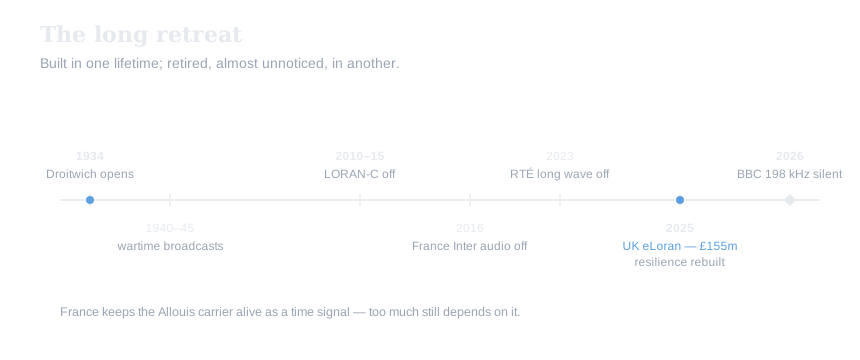
Germany’s long-wave broadcasts ended around the turn of 2015. Ireland’s RTÉ closed its 252 kHz service in 2023, after years of argument about elderly emigrant listeners, cost, energy use and the difficulty of maintaining a service whose audience was shrinking but whose emotional importance to some listeners remained intense. The Czech Topolná transmitter had already gone silent and its masts were later demolished. RTL’s long-wave service from Luxembourg ended. Europe 1’s long-wave transmitter in Saarland fell quiet. France Inter stopped broadcasting audio on 162 kHz at the end of 2016, though the Allouis carrier remains alive for time and frequency signals — too much still depends on it.
The pattern is not hard to understand.
Long wave was expensive. Audiences declined. Receivers disappeared from kitchens and cars; the transmitters consumed serious power; the spare-parts chain thinned; the workforce aged.
All of these statements can be true at once.
It is important to say that, because the easy version of this story would blame foolish administrators for dismantling a noble past. That version is emotionally satisfying and intellectually weak. The real story is more uncomfortable. Most of the decisions that killed long wave were reasonable inside the institutions that made them.
A broadcaster with a constrained budget is not irrational for spending money where the audience is. A public service broadcaster cannot maintain every platform indefinitely for a small group who value it deeply. And a modern listener with a smartphone and digital radio may reasonably ask why a national broadcaster should keep a vast analogue system running for an audience that has largely moved on.
There is no villain here. That is precisely why the story matters.
Civilisations do not usually lose resilience because one person decides to destroy it. They lose it because many people, in many institutions, make decisions that are locally sensible and collectively irreversible.
A mast does not fall because civilisation has chosen fragility.
It falls because its maintenance budget no longer survives the meeting.
A frequency does not go quiet because anyone hates resilience.
It goes quiet because the audience figures are bad, the transmitter is old, the replacement path exists, and nobody in the room is paid to represent the future emergency in which the old system might have mattered.
That is the economics of forgetting.
The savings are real, immediate and easy to count.
The loss is uncertain, deferred and almost impossible to book.
One line appears in this year’s accounts.
The other exists only as a question: what would it cost to recreate this capability if the assumptions that made it obsolete stopped holding?
The same physics, under a new name
Europe has already begun to learn that lesson in another domain.
For decades, terrestrial radio navigation looked equally obsolete: Decca and then LORAN-C were switched off as GPS proved more accurate, more global and more convenient. Then satellite navigation became part of the nervous system of civilisation — timing financial transactions, synchronising telecom networks, guiding ships and aircraft — and the more useful it became, the more dangerous its failure became. When jamming and spoofing stopped being hypothetical along Europe’s edges, Britain, having helped retire LORAN-C, began spending public money on eLoran: a terrestrial low-frequency backup to the satellites.
The same physics that once made long-wave broadcasting attractive reappears under another name when the problem becomes navigation rather than speech.
The old solution was not wrong. It was merely unfashionable until the failure mode became expensive enough to see.
This pattern reaches beyond radio.
Copper telephone networks are being retired across Europe. The argument is again strong. Digital voice services are more flexible, cheaper to operate, easier to integrate and better aligned with modern networks. Maintaining ageing copper is expensive and inefficient. The old public switched telephone network belongs to an era of electromechanical exchanges, analogue signalling and regulated monopolies.
But copper had one property that becomes visible only when it disappears. A traditional corded telephone could draw power from the exchange; in a power cut, if the exchange remained powered, the phone could still work. VoIP does not behave that way.
A fibre connection, router, cordless handset or mobile phone depends on local power, battery, network electronics and backhaul. Again, the modern system is more capable by nearly every normal measure. Again, one particular kind of persistence is lost.
The same story can be told through telegraphy and telex, through mechanical exchanges and maritime radio, through paper maps displaced by navigation screens, through sirens supplemented by cell broadcast alerts, through public information systems that assume the citizen has a charged personal device and a functioning network.
Each change is defensible. Together, they describe a shift in the default imagination of infrastructure.
The twentieth century built systems that assumed the citizen might have very little and the state might need to reach them anyway.
The twenty-first century increasingly builds systems that assume the citizen has a capable device, the device has power, the network is reachable, the backend is alive, the identity layer works, the time source is valid, and the software still trusts its dependencies.
That is not stupidity. It is the price of extraordinary capability.
But prices can be hidden.
For most of daily life, the modern bargain is overwhelmingly better. The old systems were narrow, slow and one-way: they could speak, but not listen; warn, but not coordinate at scale.
Modern systems can do all of that. Until they cannot.
In a serious blackout — as Spain and Portugal found in April 2025 — the hierarchy of technology briefly inverts.
The advanced systems fail downward. The simple systems remain.
A battery radio, almost embarrassingly modest in normal life, becomes valuable not because it is clever but because it asks so little of the world. It does not need an account. It does not need a handshake. It does not need a cell tower to authenticate it. It does not need a software update. It does not need the user to remember a password. It receives.
This is the old bargain. Low bandwidth, high persistence.
The long retreat from analogue resilience did not happen because Europe forgot how to build good infrastructure. On the contrary, Europe built extraordinary digital systems during the same period: fibre networks, mobile networks, satellite services, cloud platforms, emergency alert systems, digital identity layers, resilient data centres and software-defined everything.
The problem is subtler.
Europe became brilliant at building systems for a functioning world. It became less interested in maintaining systems for a broken one.
That difference was easy to ignore during the long peace. For decades after 1945, Western Europe’s deepest infrastructure assumptions mostly held: borders changed little, grids worked, war happened elsewhere. Dependence accumulated without the emotional memory of occupation, blackout or continental war that had shaped earlier engineering choices.
A society at peace naturally optimises for peace. It should.
The tragedy, if that is the word, is not that Europe modernised. It is that it modernised so successfully that some older questions began to sound melodramatic.
Who can speak if the network is down?
Who can navigate if satellites lie?
Who can call if the power fails?
Who can be reached if the mobile mast is dark?
Who remembers how the backup worked?
Who is responsible for a capability that is not needed this year, may not be needed next year, but might one day be the difference between confusion and continuity?
These are not nostalgic questions. They are infrastructure questions. And they are returning.
The Economics of Forgetting
The strangest thing about losing a resilience capability is that the loss usually looks financially responsible.
A transmitter costs money. So does a backup network, a specialist team, a store of spare parts, and the training of the next generation of engineers. The catastrophe in which all of this becomes useful has no invoice attached to it, because it has not happened yet.
So the accounting is asymmetrical from the beginning. The cost of keeping the old system is visible; the cost of needing it after it has gone is hypothetical. Budgets are not kind to hypotheticals.
This is why the economic case against long wave was always strong. RTÉ’s long-wave service in Ireland cost roughly a quarter of a million euros a year to operate, with most of that in electricity. To sustain it would have required capital investment. France saved millions annually by ending France Inter’s long-wave audio service from Allouis. RTL’s long-wave transmitter consumed thousands of megawatt-hours each year. The BBC did not publish a clean public figure for the running cost of Radio 4 long wave, but the shape of the cost was obvious: rent, power, maintenance, specialist engineering, ageing high-power equipment and a shrinking audience.
No serious editor, engineer or public official could ignore that.
If a service has few listeners, consumes large amounts of power, depends on ageing hardware and requires capital investment, its defenders must answer a hard question:
Why should the public pay?
The question is legitimate, but it is incomplete. The better question is: what exactly is the public paying for?
If the answer is only “a radio programme,” or “a culturally beloved but outdated platform,” long wave loses. But if the answer is “a national communications capability with unusual persistence under degraded conditions,” the calculation changes — not necessarily enough to save it, but enough to make the decision more serious than a platform migration.
Pricing services vs pricing capabilities
This is where modern institutions struggle. They are good at pricing services. They are worse at pricing capabilities.
A service has users; a capability has scenarios. A service produces metrics; a capability produces assurance. A service can be evaluated by audience share, cost per listener and energy use; a capability must be weighed against rare events whose probability and timing are uncertain. That is much harder to defend in a meeting. A radio executive can say how many people still tune in, an energy manager how much power the transmitter draws, a finance director what maintenance costs — but who in the room can price the value of a signal that still works in the crisis nobody has budgeted for?
This is not unique to broadcasting. It is one of the central problems of resilience.
A hospital generator looks expensive until the grid fails. A strategic fuel reserve looks inefficient until supply chains fracture. A spare analogue path looks like duplication until the digital path fails.
The trouble is that the moment of vindication arrives only after the earlier savings have already been booked.
Long wave lived in exactly that category.
The annual savings from shutting transmitters were real. They were measurable. They could be justified to boards, regulators and governments. Yet the capability being retired was not easily replaced by any single modern system, because no single modern system had been designed to do the same thing.
Internet streaming replaced the programme-distribution path for normal listeners under normal conditions. DAB replaced domestic listening within digital coverage. Mobile networks created an extraordinary two-way layer dependent on dense infrastructure, power and backhaul. Cell broadcast created a far better way to send targeted alerts, but not a way to sustain national speech through a prolonged failure.
These are not inferior systems. They are different systems.
The economic mistake is to treat functional replacement in normal life as capability replacement in abnormal life.
The same error was made with terrestrial navigation.
GPS and other satellite navigation systems were so useful, accurate and cheap at the point of use that older terrestrial systems seemed indefensible. LORAN-C could be shut down. Decca could be retired. The future was in space.
For ordinary use, that judgement was correct. For resilience, it was incomplete.
When governments later began worrying seriously about GNSS jamming and spoofing, the old terrestrial idea returned. Not in the same form, and not for the same institutional reasons, but with the same underlying lesson: a signal generated on Earth, difficult to spoof at scale and independent of satellites, has value precisely because it is not part of the dominant system.
The United Kingdom’s decision to invest in eLoran and wider positioning, navigation and timing resilience is therefore one of the most revealing infrastructure stories of the decade. It is less a navigation policy than an admission: that the most efficient system under normal conditions may not be sufficient under contested ones.
The numbers sharpen the point.
A serious disruption to satellite navigation could cost the UK economy enormous sums in a matter of days. The British government’s own analysis puts a single 24-hour GNSS outage at around £1.4 billion. Against that, the £155 million it committed in 2025 to begin rebuilding terrestrial resilience — about a ninth of one day’s loss — is not trivial, but it is modest compared with the cost of losing the signal everyone assumed would be there.
| What was switched off (or is) | Saving or cost | What the number hides |
|---|---|---|
| RTÉ long wave (Ireland) | ≈ €250k / year | A small annual saving against the loss of diaspora reach and a national reserve channel |
| France Inter / Allouis audio | ≈ €6.5m / year | A genuine saving — yet the carrier was kept alive as a time signal, because too much still depended on it |
| RTL long wave (Luxembourg) | ≈ 6,000 MWh / year | The energy argument was real and legitimate |
| UK eLoran / PNT resilience | £155m investment (2025) | The cost of rebuying terrestrial resilience after a generation of satellite dependence |
| A single GNSS outage | ≈ £1.4bn per 24 hours | One day’s failure dwarfs the annual savings discussed here |
This is the arithmetic of forgotten infrastructure.
Spend a little, every year, to preserve a capability that may never be needed.
Or save the money, every year, until the day the absence of the capability becomes expensive all at once.
The first looks wasteful. The second looks efficient. Until the assumptions reverse.
Long wave never had a clean version of this calculation. There was no official table showing the cost of maintaining BBC Radio 4 long wave against the value of national resilient broadcast capacity in an extended power or network emergency. There was no line item for historical memory. No budget category for “a signal that can still be received by a cheap battery radio when richer systems fail.” No obvious institutional owner for the residual national-security value of a broadcast network whose audience had moved elsewhere.
The BBC was responsible for broadcasting.
Energy companies were responsible for the Radio Teleswitch Service.
Emergency planners were responsible for public warning.
Telecom operators were responsible for networks.
Government departments were responsible for resilience.
Arqiva owned and operated transmission infrastructure.
Listeners simply listened.
The capability sat between institutions. And capabilities that sit between institutions are the easiest to lose: everyone can explain why it is not quite their job.
This may be the most important lesson in the economics of forgetting: resilience is often cross-institutional, while budgets are not. The benefits of keeping a capability may be distributed across society. The costs sit on one balance sheet.
That imbalance almost guarantees erosion.
A broadcaster sees power bills; a government sees no immediate crisis; a regulator sees an old platform; a finance department sees savings; an emergency planner, perhaps, sees a question. But by then, the transmitter may already be gone.
Losing the workforce, not just the machine
There is a second kind of cost, harder still to price.
A machine can sometimes be rebuilt. A workforce is more difficult.
When long-wave transmitters close, what disappears is not merely the carrier but the routine of keeping such systems alive — the people who understand high-power RF at this scale, the firms that can raise and maintain very tall masts, the technicians who have spent decades listening to the moods of valves and earth currents.
Some of that knowledge remains. Modern high-power transmitters exist; tubes can still be made in specialised cases. The romantic story that “nobody alive can make this anymore” is too simple.
The truth is quieter. We can still do many of these things. But we no longer routinely choose to.
That distinction matters. A capability does not disappear only when it becomes impossible. It also disappears when it becomes institutionally unnatural.
When no young engineer sees a career path in it.
When no procurement team knows how to buy it.
When no minister wants to defend it.
When no broadcaster wants to fund it.
When no public remembers why it was there.
At that point, rebuilding is not merely a technical project. It is an act of cultural recovery.
This is why the story of long wave belongs beside the story of eLoran, copper telephony, blackouts and satellite jamming. Each concerns a different technology. Each has its own economics. Each can be debated on its own merits.
But together they reveal a habit.
A society enjoys the fruits of robust legacy systems long after the fear that built them has faded. It then retires them under the pressure of efficiency. Later, when the world becomes less benign, it discovers that efficiency and resilience were never the same thing.
Nothing in this argument proves that BBC Long Wave should have remained on air forever. That is not the claim.
A 1930s transmitter network cannot be preserved indefinitely simply because it once mattered. The receiver base had collapsed. The audience had changed. The hardware was old. The BBC had other obligations. The electricity was real. The maintenance was real. The opportunity cost was real.
If I had been sitting around the table in 2026, looking only at the broadcaster’s responsibilities, I might well have voted to switch it off too.
That is the unsettling part. The decision was reasonable. The outcome may still be a warning.
Because the final disappearance of 198 kilohertz was not caused by one irrational act. It was caused by the accumulation of rational ones. Each decision made sense in its own frame. Each budget line was defensible. Each migration had a logic. Each closure had an explanation.
And then, at the end of the process, Europe had one fewer way to speak when the ordinary world fails.
No one had set out to make that happen. Which is exactly how it happens.
The Cloud Paradox
This is the uncomfortable part for those of us who build modern infrastructure.
I do not distrust cloud systems. I build them.
I spend my working life thinking about regions, routing, identity, storage, observability, replication, dependency chains and failure domains. I know how much stronger modern digital infrastructure can be than the systems it replaced. A well-designed cloud platform can survive hardware failure, route around local damage, replicate data across sites, absorb traffic spikes and recover from incidents at a speed that would have seemed miraculous to earlier generations of engineers.
That is why the lesson of long wave is not that modern infrastructure is weak. It is that modern infrastructure is often strong in a different way.
Redundancy is not persistence
The word we use most often is resilience, but we sometimes hide several meanings inside it.
A cloud service is resilient because it runs in several availability zones; a database because it has replicas; an application because it has failover, retries and monitoring.
These are real strengths. They are also mostly forms of redundancy.
Redundancy is the art of surviving component failure inside a functioning system.
Persistence is something else. Persistence is the art of continuing when the surrounding assumptions begin to fail.
That distinction sounds abstract until a real outage arrives.
On 28 April 2025, when a large blackout hit Spain and Portugal, the visible failure was electrical. But the operational problem was wider. As power disappeared, connectivity degraded. As connectivity degraded, organisations lost not only services but visibility. Routing, authentication, monitoring, payment systems, mobile networks and operational coordination all became entangled with the same basic fact: infrastructure that feels digital is still physical.
I wrote about this at the time in “When the grid goes dark: infrastructure dependency in Europe,” because the lesson was not merely that power can fail. Everyone knows that. The lesson was that a blackout in one place rarely remains local in modern infrastructure. When identity, DNS, storage, routing or operational platforms sit outside the affected region — or depend on systems that do — a regional event becomes a distributed operational problem.
Even after electricity returns, systems do not simply resume where they left off.
Services restart, databases resynchronise, queues drain, routes stabilise; monitoring has to become trustworthy again, and operators must distinguish between recovery and the appearance of recovery.
There is a gap between restored power and restored confidence. That gap is where dependency becomes visible.
Long wave belonged to a different dependency model.
It did not require the listener’s broadband router, a phone mast, a DNS lookup, a cloud identity provider, or a functioning payment network, app platform or certificate chain. It did not even require the listener to know where the transmitter was.
The receiver needed power, an antenna and enough atmosphere to carry the signal. That was almost all.
This is not a romantic point. It is an architectural one.
The deeper issue in modern infrastructure is not that we lack redundancy. In many places, we have more redundancy than ever. The issue is that our redundancy often sits inside shared dependency layers. If the same identity provider, timing source, DNS provider, cloud control plane, energy grid, fibre corridor or operational toolchain underpins several supposedly separate services, their independence may be more apparent than real.
We can duplicate the application and still share the failure. We can replicate the data and still depend on one identity layer. We can run in several regions and still need a control plane reachable from outside them.
This is the hidden dependency layer of modern systems. It often remains invisible precisely because the systems work so well. Only failure draws the map.
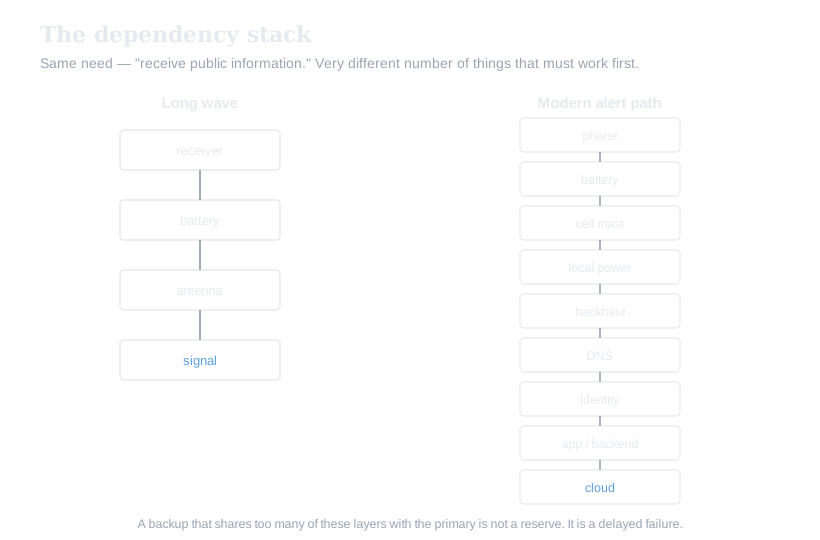
The point is not to reject complexity. Complexity is the price of capability. We want two-way communication. We want maps, translation, authentication, video, secure messaging, searchable archives, live telemetry and targeted emergency alerts. None of that can be delivered by a long-wave transmitter reading a bulletin into the night.
But complexity should make us more humble about reserve, not less.
Independent, not merely redundant
A modern society does not need to preserve every old system. It does need to ask whether its new systems have genuinely independent fallbacks.
That is the missing word in much of the resilience conversation: independent. Not merely redundant. Independent.
A second cloud region is valuable.
But it is not fully independent if both regions share the same identity plane, deployment pipeline, DNS authority and timing source — reached by the same operators through the same failing network.
A second fibre route is valuable.
But it is not fully independent if both routes share a duct, landing station, power feed or administrative control.
A mobile alert is valuable.
But it is not fully independent if the masts have only a few hours of battery and the public needs sustained information after those batteries die.
A satellite service is valuable.
But it is not fully independent if terminals need local power, clear sky, functioning ground stations and a contested spectrum environment.
A backup that shares too many assumptions with the primary is not a reserve. It is a delayed failure.
Long wave was crude by modern standards, but it had one rare property: it was independent of many of the systems that now form the ordinary communications stack. Its bandwidth was tiny. Its audio was narrow. Its transmission costs were high. It could not authenticate users, route messages, target postcodes or show maps. It could not tell whether anyone had heard it.
But it could speak when many richer systems could not.
That is why the loss matters — not because 198 kilohertz was the answer to modern resilience. It was not.
The receiver base had declined too far. The infrastructure was too old. The economics were too unfavourable. The public had moved on. In a practical emergency plan for the 2030s, nobody sensible would simply write “bring back BBC Long Wave” and call the problem solved.
The real question is harder.
What is the twenty-first-century equivalent of a reserve signal? What reaches people when power is intermittent and mobile networks degrade? What is simple enough that ordinary people can use it under stress, and independent enough that it does not fail with the systems it is meant to back up?
These are not questions for nostalgia. They are design requirements. And they matter especially to those of us who believe in modern infrastructure, because belief without reserve becomes fragility.
The cloud industry is full of language about resilience. Much of it is justified. Some of it is marketing. The best engineers know the difference. They know that a system diagram can look beautifully redundant while still depending on one unexamined assumption. They know that failures rarely respect product boundaries. They know that the most dangerous dependency is often the one nobody wrote down because it was always there.
Electricity.
Time.
Identity.
Name resolution.
Physical access.
Human coordination.
Trust.
The old long-wave engineers could not build what we build now. But they understood, in their own world, that a communications system is only as resilient as the assumptions it can survive losing.
That is the lesson worth carrying forward.
Not valves.
Not nostalgia.
Not the romance of crackling audio in the dark.
The lesson is reserve.
A civilisation should be able to answer a simple question:
If the beautiful system fails, what remains?
In 1934, one answer rose on steel masts above Worcestershire.
In 2026, it fell silent.
The question did not.
The State That Can Still Speak
A state is not only the territory it controls. It is also the people it can still reach.
That statement sounds obvious until the channels begin to fail.
In ordinary times, public communication is fragmented almost beyond recognition — websites, press conferences, social media, emergency alerts, broadcasters, apps, telecom operators, health portals — and citizens receive it through phones, browsers, televisions, radios, messaging groups and rumours.
The result is noisy, but usually sufficient. In a crisis, the abundance becomes more fragile.
A warning that depends on a phone does not reach a phone that is out of power. A website does not reach a household without connectivity. A government app is only useful if people installed it, trust it and can reach its backend. A press conference is not a message unless the distribution chain holds.
The old broadcast model was crude, but its political meaning was clear: one authority could speak outward to everyone within reach of the signal. It was not interactive. It was not personalised. It did not know who was listening. But that was also its strength. The state did not need to know the listener. The listener did not need to authenticate. No account had to exist. No network session had to be established. The message simply propagated.
That is not enough for modern government. But it is still something modern government should know how to do.
This is the state-capacity question hidden inside the end of long wave.
Can the state still speak when normal communications are degraded, contested or dependent on infrastructures outside its direct control?
Can the state still speak?
For most of the postwar era, that question could be kept in the background. Europe’s core assumptions were stable enough. The grid worked. Telecoms expanded. Public broadcasters modernised. Satellites became routine. The Internet became ordinary. GPS became invisible. Subsea cables became the ocean floor’s hidden utility. Cloud infrastructure became the default place where public and private services lived.
The system worked so well that its dependencies stopped feeling like choices. Then the edges began to wobble.
GNSS jamming and spoofing, once niche military concerns, became recurring facts across Northern and Eastern Europe; aircraft crews met unreliable navigation, and the Baltic learned that signals from space could be denied from the ground. The cables and pipelines under the same sea — long treated as background plumbing — were damaged, investigated and discussed as strategic assets. And the Iberian blackout showed how quickly a modern society moves from electrical failure to communications failure to operational uncertainty.
Each incident belongs to its own domain — navigation, subsea infrastructure, electricity, telecoms, cloud, broadcasting — but together they point to the same institutional problem: modern states increasingly depend on systems they do not fully own, cannot fully harden, and may struggle to operate through when several fail together.
This does not mean the old state-owned monopoly world was better; it often was not, and modern societies gained enormously from open networks, competition and commercial innovation. The answer is not autarky, nor a complete sovereign stack for every function.
The answer is to know which dependencies must have reserves.
A state does not need to own every cable, but it does need to know what happens if several are cut. It does not need to operate every data centre, but it does need to know which public functions depend on whose cloud, identity system and timing source. It does not need to abandon satellite navigation, but it does need a plan for when it is degraded. It does not need to preserve every analogue transmitter, but it does need a way to reach people when mobile, broadband and app channels are no longer reliable.
This is not ideological. It is operational.
The language of digital sovereignty often becomes abstract, but the practical question is simple: can essential functions continue when the preferred systems are unavailable?
Not perfectly, not elegantly, not with every feature — but enough. Enough to warn, to coordinate, to reassure, to keep public authority present. That last word carries the weight: present.
One of the lessons of wartime broadcasting is that communication is not only information transfer. It is the presence of legitimate authority under stress. When Haakon spoke from London, the value was not merely the semantic content of a speech. It was the fact that the King still spoke. When a population heard its own language from outside occupation, the broadcast carried a political meaning no printed order could replicate.
Modern states rarely face occupation in that form. But they do face degraded environments: cyberattacks, disinformation campaigns, blackouts, jamming, sabotage, extreme weather, regional isolation and cascading infrastructure failures. In those conditions, silence is not neutral. If legitimate institutions cannot speak, others will.
Rumour will.
Adversaries will.
Fraudsters will.
Panic will.
The public information vacuum is never empty for long.
An alert is not a conversation
This is why emergency alert systems, useful as they are, cannot be the whole answer. Cell broadcast is excellent at sending short warnings quickly to phones in a defined area. It is vastly better than long wave for immediate targeted alerts: leave this area, avoid this road, shelter indoors, test message only. It belongs in every modern resilience system.
But an alert is not a conversation with the public. It is the beginning of one.
After the alert comes the harder phase: sustained explanation, correction, reassurance, instruction, updates, and the slow work of making people believe the information they receive. That phase requires channels that survive beyond the first minutes of a crisis.
Broadcast radio has historically served that role — not because it is advanced, but because it scales without asking much from the receiver.
The state-capacity question, then, is not whether long wave should be restored exactly as it was. It is whether anything now occupies the same category of independence and reach.
If the answer is yes, it should be named, tested and funded.
If the answer is no, the absence should be admitted.
What should not happen is the quiet substitution of one capability for another simply because both are called communication.
A push alert is not a broadcast network. A streaming service is not an emergency reserve if the access network is gone. A cloud-hosted status page is not operational visibility if the cloud dependency is part of the incident.
These distinctions sound pedantic until the day they become practical. They are the difference between having many channels and having a reserve.
Norway understands this question better than many countries, whether it always says so explicitly or not.
Its geography teaches dependency: long coastlines, dispersed settlements, sea routes, offshore energy and a strategic position on Europe’s edge all make communication more than a convenience. During occupation, the question was how the legitimate Norwegian state could remain audible from exile. In the present, it is how a highly digitised country remains reachable and operational when the infrastructures beneath daily life are stressed.
The form has changed. The principle has not.
Who can still reach you when someone is trying to cut the line?
That line may be a cable, a satellite signal, a power feed, a DNS dependency, a trust relationship — or the public’s confidence that the message is real.
The deeper a society digitises, the more seriously it must take the physical and institutional foundations beneath the digital layer. Not because digitisation is a mistake, but because the opposite is true: digitisation succeeds so completely that its foundations become critical.
The old long-wave transmitters made their foundations visible: you could see the mast, store the fuel, name the engineers, and point to the place from which the state spoke.
Modern foundations are harder to see. They are contractual, logical, distributed, virtualised and often transnational. That does not make them unreal. It makes them harder for democratic societies to reason about. Citizens can see a fallen mast. They cannot easily see a broken trust chain, a dependency on a foreign identity provider, a congested peering link, a jammed timing signal or a degraded cloud control plane.
Invisible infrastructure is still infrastructure. And invisible dependence is still dependence.
The disappearance of 198 kilohertz does not mean Europe can no longer speak. Europe has more communication capacity than at any point in human history. More channels, more devices, more bandwidth, more storage, more compute, more languages, more immediacy.
But the relevant question is narrower.
How much of that capacity remains when the environment is hostile — when the grid is unstable, satellite signals are unreliable, subsea routes are damaged, cloud identity is unreachable?
How much remains for the citizen with no battery, no broadband, no working mast nearby and no confidence in the rumour circulating on a messaging app?
That citizen is not theoretical. In every large crisis, someone becomes that citizen.
The measure of public resilience is not how well the best-connected person receives information when everything works. It is how well the least-prepared person can still be reached when things do not.
Long wave answered that question in one old, narrow way. Its answer is gone. The state still needs one.
What Disappears When the Technology Disappears
A signal can vanish in an instant. A capability takes longer to die.
That distinction is easy to miss because the public moment of disappearance is so clean. The switch is thrown. The carrier drops. The meter falls. The spectrum analyser shows a gap where a line used to be. Someone records the final minutes and uploads them to the Internet, where the death of one medium survives as content on another.
But the real disappearance happened earlier.
It happened as spare parts became harder to source, and as the engineers who knew the system moved toward retirement. It happened when young people stopped entering the speciality, when maintenance became an exception rather than a culture, when the technology stopped feeling like a living field and started feeling like heritage.
By the time a transmitter goes silent, much of what made it a capability has already gone.
The myth of the irreplaceable valves
This is why the famous story of Droitwich’s valves is both useful and misleading.
For years, accounts of BBC Long Wave’s future returned to the same almost gothic detail: the service depended on enormous glass valves, fewer than a handful remained, and when they failed the transmitter would die. It is a wonderfully memorable image. A national signal, held alive by ageing tubes in a transmitter hall; the modern world waiting for a piece of twentieth-century glassware to crack.
There is truth in it. There is also myth.
Former BBC engineers have argued that the valves were not literally impossible to manufacture. Specialist firms could, in principle, make high-power tubes to order. Modern solid-state transmitters could replace older valve systems. Long-wave transmission is not lost science. Morocco, Poland and other sites show that high-power low-frequency broadcasting is still technically possible. The laws of physics have not changed.
That is exactly why the deeper loss is more interesting.
The problem is not that Europe suddenly became unable to build such systems. It is that it gradually stopped being the kind of society that routinely chooses to.
That is a quieter sentence, but a more serious one.
An impossible technology invites romance.
An uneconomic technology invites a budget note.
A neglected capability invites neither.
It simply fades from the list of things a society expects itself to know how to do.
The knowledge behind long wave was never only in textbooks. It was in hands, habits and judgement: knowing how a transmitter sounds when it is healthy, how a matching network behaves in weather, how a mast ages, how a valve fails slowly before it fails visibly.
Modern infrastructure has its own tacit knowledge, of course.
A skilled site reliability engineer carries the same kind of practical intuition in another medium: logs, latency, traces, deployments, saturation, retries, queues, certificates, routing tables, incident channels, customer reports. Every technical age produces its own craft.
But older crafts do not remain available merely because their principles are understood. They must be practised.
A country may understand the theory of shipbuilding and still lose the industrial base to build certain ships. It may understand vaccine production and still lack domestic manufacturing capacity. It may understand radio propagation and still lack the people, suppliers, permissions and institutional appetite to build a high-power long-wave network when one is suddenly needed.
Capability lives in ecosystems. Not in diagrams.
Droitwich was one such ecosystem.
There were masts and transmitters, yes. But there were also riggers, RF engineers, power engineers, valve suppliers, site technicians, planners, spectrum agreements, maintenance schedules, safety procedures, specialist knowledge and institutional memory. The site made sense because an entire world around it still knew what it was for.
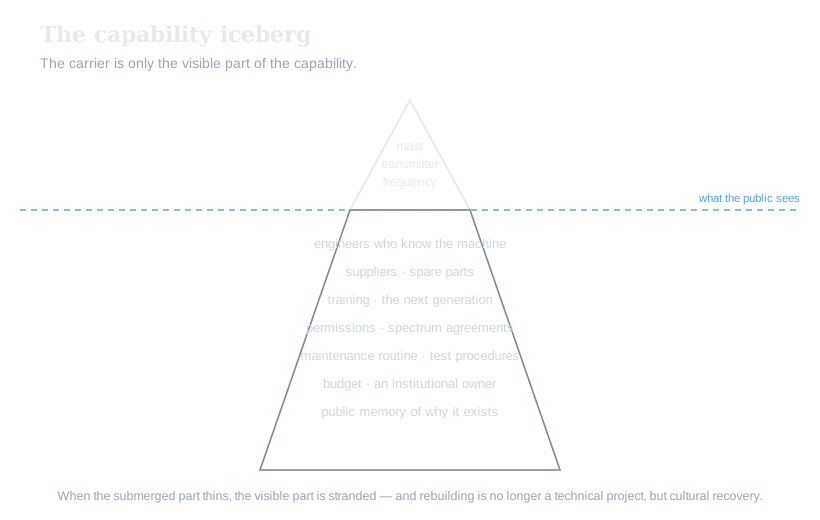
When that world thins, the object becomes stranded.
A mast remains.
A hall remains.
A frequency remains.
A file of drawings remains.
But the social machinery that made them useful becomes fragile.
This is the fate of many old infrastructures. They often survive physically after they have died institutionally. A railway line remains visible after the trains stop. A canal remains after freight leaves it. A telephone exchange building remains after the switches are removed. A radio mast remains after the audience disappears.
The object outlives the system. And because the object is still there, the loss can be underestimated.
People say: the mast still stands.
They say: the frequency could be reused.
They say: the technology still exists.
Sometimes they are right. But a system is not rebuilt by pointing at its remains. It is rebuilt by restoring the ecosystem of competence, money, authority and use that once made the remains meaningful.
That restoration is usually much harder than preservation would have been.
The same pattern appears in the demolition of long-wave masts across Europe. Once a mast is felled, the loss feels final in a way a silent transmitter does not. Steel on the ground is easier to understand than knowledge leaving a profession. Yet the mast is only the most photogenic part of the disappearance. The more consequential loss may have occurred years earlier, when the last generation of people who regarded such structures as ordinary working infrastructure stopped being replaced by another.
Heritage is not reserve
A society can preserve heritage without preserving capability. It can celebrate the Shipping Forecast as cultural poetry while removing the infrastructure that made it reach far beyond land. It can save the story and lose the function.
There is nothing inherently wrong with heritage. A civilisation should remember its machines. Museums, archives, photographs and oral histories matter. They preserve humility. They remind a digital age that it did not invent complexity.
But heritage is not reserve. A preserved control panel cannot transmit. A documentary cannot warn a population. A recording of a final broadcast cannot make the signal return.
This is the painful difference between memory and capacity. One can survive as culture after the other has disappeared as infrastructure.
The end of long wave therefore asks a broader question than whether old radio transmitters should be saved. It asks how societies decide which forms of knowledge remain active.
Some knowledge is allowed to become obsolete because the problem it solved has genuinely gone.
Other knowledge becomes obsolete because we have chosen a different solution.
But some knowledge becomes obsolete because the problem has merely gone quiet.
The problem of speaking to a population through degraded infrastructure has not gone. Nor has the problem of reaching people at sea, in valleys, in blackouts; nor national continuity under pressure; nor trusted public information in a hostile environment.
Only one of the older answers has gone. That should make us careful — not because we should rebuild every old answer, but because we should be certain we have new ones.
In technical culture, there is a dangerous kind of confidence that comes from substitution. We replace an old system with a new one that performs the visible task better, then conclude that the old system’s entire role has been replaced. Sometimes that is true. Often it is only partly true.
A smartphone replaced many everyday tools, but not the independence of all of them. GPS replaced older navigation methods for most users, but not the need to navigate when GPS is denied. Internet streaming replaced broadcast listening for many people, but not, automatically, the public-resilience function of broadcast.
The visible function was replaced. The hidden function was not always named.
Long wave’s visible function was radio programming. Its hidden function was reserve speech.
That phrase is imperfect, but useful. Reserve speech: the capacity to speak outward at scale through a path that does not share the ordinary dependency stack.
Every state needs some version of that. Every large society does.
The form may differ. It may be hardened FM. It may be a modernised low-frequency service. It may be satellite public channels with battery-capable receivers. It may be local broadcast cells, sirens, community relays, emergency mesh networks, public information caches, printed protocols, amateur radio integration, or combinations not yet designed.
The answer need not be nostalgic. But it must be real.
A reserve that exists only in a strategy document is not a reserve.
A reserve that depends on the same outage domain as the primary is not a reserve.
A reserve that ordinary people cannot use is not a reserve.
A reserve that no one tests is not a reserve.
A reserve that no institution owns will eventually cease to exist.
This is perhaps the most uncomfortable part of the long-wave story. Its disappearance was not only technical or economic. It was institutional. At some point, the capability no longer had a natural guardian.
The BBC could not justify it as a mainstream audience service. Energy companies treated the Radio Teleswitch Service as a migration problem. Emergency planners had newer tools; telecom operators were building digital networks; Arqiva had assets to manage; listeners had moved on.
Each actor saw a different fragment. No actor owned the whole. And so the whole disappeared.
This is how complex societies forget. Not by erasing memory, but by distributing responsibility so widely that no one has enough of it to act.
The final carrier drop at Droitwich was therefore both tiny and enormous. Tiny, because almost no one depended on it for daily life anymore. Enormous, because it marked the end of a certain expectation: that a European state should maintain a physically independent means of speaking across distance when more sophisticated systems fail.
Perhaps that expectation should have ended. Perhaps the new systems are enough.
That is possible. But it should be demonstrated, not assumed.
The history of infrastructure is full of systems whose value was recognised only after failure. The cheap thing, the old thing, the redundant thing, the boring thing, the unfashionable thing — all look inefficient until the day they become the only thing still working.
The lesson is not to worship old machines. It is to ask what role they played before allowing the role itself to vanish.
A frequency can be silent.
A mast can be demolished.
A valve can cool.
A generation of engineers can retire.
The question remains in the air after the carrier is gone:
What, exactly, replaced it?
The Last Voice of Europe
In the end, the silence was not dramatic. That is worth remembering.
No city went dark when 198 kilohertz disappeared. No emergency failed because the carrier fell. No government lost the ability to address the nation that morning. No ship was suddenly blind. No household, in any ordinary practical sense, was thrown back into the anxieties of an earlier century.
For most people, nothing happened.
A streaming app still worked.
A phone still connected.
A car still paired over Bluetooth.
A smart speaker still answered.
A website still loaded.
The world did not pause to mark the absence of a signal almost nobody used anymore.
That is why the closure was possible. It is also why it matters.
Some infrastructure announces its importance every day. Roads fill with traffic. Airports fill with passengers. Power lines hum above fields. Mobile masts stand on rooftops. Data centres consume land, water, electricity and political attention. Their usefulness is visible because their failure would be immediately inconvenient to millions.
Other infrastructure exists for the day ordinary convenience is no longer the question.
It waits.
It is overbuilt by normal standards.
It is boring by design.
It is expensive to maintain and difficult to defend during long periods when the catastrophe does not arrive.
Its success is indistinguishable from irrelevance.
Until it is needed.
Long wave belonged to that second category.
Not entirely, of course. For most of its life it was also ordinary broadcasting: news, weather, sport, speeches, drama, music, ritual. Millions used it without thinking of war, blackout or national continuity. A technology does not have only one meaning because engineers or states imagined one serious purpose for it.
But beneath the programming was a deeper design choice.
A few hardened transmitters.
A vast physical antenna.
Independent power.
Simple receivers.
Large-area reach.
Low dependence on intermediate systems.
A signal that could be heard without asking the listener to join a network.
That design choice came from an age that had not yet learned to take peace for granted.
It is tempting to say that Europe forgot the lesson. The truth is gentler and more troubling. Europe did not forget all at once. It remembered less each year.
The wartime listeners died.
The engineers retired.
The radios left kitchens.
The dials disappeared from dashboards.
The spare parts became strange.
The masts became heritage.
The audience became small.
The service became expensive.
The arguments for closure became stronger.
The memory of why such systems had once seemed indispensable became weaker.
Then the final decision arrived not as a civilisational turning point, but as an operational fact.
A date.
A time.
A shutdown.
The easiest stories about technology are stories of replacement. The new arrives, the old departs, and progress moves forward. Those stories are often true. They are also incomplete. Replacement is not a single act. A new system may replace one function of an old one while leaving another function unnamed. If no one names the leftover function, it does not appear as a loss.
It appears as efficiency. That is what happened here.
The programmes moved.
The listeners moved.
The meters moved.
The platforms moved.
The budget moved.
But the reserve did not clearly move anywhere.
Perhaps it exists elsewhere now, in a form better suited to the present. Perhaps the combination of cell broadcast, FM, satellite, local emergency planning, public broadcasters, mobile networks, cloud platforms and hardened government systems is enough. Perhaps, in a real crisis, the modern stack will prove more resilient than the old broadcast engineers could ever have imagined.
That may be true. It should be tested like a serious claim, not assumed like a comforting one.
Because the question raised by the end of long wave is not whether Europe should preserve every obsolete system. It should not. A civilisation that cannot retire old technology becomes a museum with electricity.
The question is whether Europe knows, with sufficient precision, which capabilities it is retiring.
A platform can be obsolete while a capability remains necessary.
A transmitter can be outdated while the need for independent public speech persists.
A radio service can lose its audience while the architecture behind it still carries a lesson.
A mast can be uneconomic while the problem it once solved returns under another name.
This is why the story loops back to eLoran, to blackouts, to jammed cockpits, to subsea cables, to phones without power, to identity systems out of reach, to the state that still needs to speak when ordinary channels become unreliable.
Again and again, the modern world discovers that it has not abolished geography, physics or dependency.
It has rearranged them.
The cloud is physical.
Satellites can be jammed.
Cables can be cut.
Masts need power.
Batteries empty.
Identity systems fail.
DNS matters.
Time is infrastructure.
Trust is infrastructure.
And in a crisis, communication is not merely a service.
It is a public function.
Long wave was one old answer to that function.
It was narrow, expensive, limited and increasingly out of place in the ordinary communications life of the twenty-first century. It could not carry maps, video, secure messages, localised instructions or two-way coordination. It was not a substitute for modern systems, and it should not be turned into a symbol of everything modernity supposedly lost.
But it did one thing with unusual independence.
It spoke outward.
Across distance.
Across borders.
Across water.
Across failure.
For a time, that mattered so much that states built machines the size of cathedrals to make it possible.
And then, after a long peace, it mattered so little that one of the last of them could fall silent almost unnoticed.
That is not an accusation. It is a warning of a quieter kind.
The most consequential infrastructure losses are not always the ones that cause immediate failure. Sometimes they are the losses that remove a layer of reserve while everything else is still working. By the time the missing layer is needed, the people, machines and institutions that maintained it may no longer exist in working form.
This is the lesson that should survive the carrier.
Not that long wave must return.
Not that old technology is morally superior to new technology.
Not that the BBC made an irrational decision.
The lesson is that resilience is not something a society possesses simply because it has many advanced systems. It is something it must design deliberately, fund patiently, test honestly and preserve even when the reason for preserving it has grown unfashionable.
A reserve is only a reserve if it survives the assumptions that make the primary system fail. Everything else is decoration.
On the morning of 27 June 2026, a transmitter in the English countryside stopped doing what it had done for nearly a century. The spectrum did not mourn. The sky did not change. Europe continued scrolling, streaming, routing, authenticating, synchronising and speaking through systems of astonishing power.
But somewhere beneath all that capacity, one older possibility disappeared.
The possibility of a simple receiver, a distant mast and a voice that did not need the rest of the network to be alive.
Every civilisation leaves behind monuments. Some are built from stone. Others are built from steel, copper and electromagnetic waves.
For ninety years, one of Europe’s great invisible monuments stood not in a square or on a hilltop, but in the air itself — a continuous human claim against distance, darkness, weather, occupation, blackout and silence.
Then, at one o’clock on a quiet Saturday morning, it fell.
Almost nobody noticed.
Sources
- BBC Radio 4 Long Wave shutdown — RSGB; Hackaday, "Requiem for Long Wave"; SWLing Post
- Droitwich Transmitting Station — BBC engineering history, "Droitwich Calling"; Wikipedia; build cost and the ten riggers — BBC News
- Ground-wave propagation — Wikipedia
- The Shipping Forecast at sea — Libby Purves, Yachting Monthly
- BBC as national infrastructure — John Reith; the Lucerne Plan, 1933; Deutschlandsender
- Wartime broadcasting to occupied Europe — Radio Londres; the Verlaine D-Day signal, correcting the Longest Day myth — dday-overlord.com; Radio Oranje; BBC og Danmark 1940–45
- Norway — King Haakon VII and "Kongens nei"; Toralv Øksnevad, "Stemmen fra London"; 1941 radio confiscation and clandestine listening
- The European retreat — RTÉ closure; Allouis carrier as time signal; LORAN-C
- The economics — RTÉ running cost; France Inter / Allouis saving; RTL energy use; UK eLoran / PNT £155m package; economic impact of a GNSS outage
- Modern dependency — When the grid goes dark: infrastructure dependency in Europe; the 2025 Iberian blackout (ENTSO-E)
- State capacity — GNSS interference over Europe (IATA); Baltic Sea cable disruptions
- The valve question (contested) — former BBC engineers on whether the valves could still be made; solid-state long wave still built — Nador, Morocco
A note on contested points: the 1934 build cost rests on a single local-historian account; the Marconi-era frequency figures, the precise meaning of the Verlaine signal, and the "irreplaceable valves" story are all disputed, and are presented here with that uncertainty intact.