
Summary
Today’s earthquake in the Oslo region of Norway was not a disaster, and fortunately it caused no major damage. That is exactly why it matters. A moderate quake with no major damage was still enough to trigger uncertainty, flood communication channels and expose a weak middle layer between no official alert and full emergency warning. In a modern city, resilience is not only about what collapses. It is also about how quickly uncertainty itself becomes an infrastructure problem.
At 09:24:53–09:24:54 local time, a moderate earthquake was registered in the Oslo region of Norway. It was clearly felt across large parts of Eastern Norway. The official public picture that followed was calm and, in the end, reassuring. But the first minutes are what matter here.
According to the official Politiloggen, police confirmed at 09:34 that an earthquake had been felt across large parts of Øst police district. At 10:37, they wrote that no significant damage had been identified and that no areas were considered dangerous to stay in. At 11:12, they warned that aftershocks could occur later in the day. At 11:34, they added that expert input did not indicate increased danger of follow-on events such as rockfall or landslides.
That was the stable version.
Before that, the city was dealing with something else: ambiguity. According to Nettavisen, police did not initially know that the event was an earthquake. A bomb was reportedly one of the early working hypotheses. Preparedness resources were alerted. Emergency lines were flooded. That detail matters, because it shows what a moderate earthquake can still do in a dense urban region: not destroy the city, but overload its need for explanation.
The first problem was not damage. It was uncertainty.
Detection is not the same as explanation
Earthquakes are not predicted in the cinematic sense. They are detected very quickly after they begin. Seismometers register motion in the ground, networks estimate location and magnitude, and specialists refine the picture as more data arrives. Magnitude describes the energy released at the source. Intensity describes how strongly the shaking is felt and what effects it has in different places. That distinction is simple, but important. A moderate earthquake can still feel dramatic in a built-up region even when the event itself is not large in global terms. See How Do We Measure Earthquake Magnitude?.
Norway already has the listening layer. NORSAR is part of the Norwegian National Seismic Network, which continuously monitors earthquake activity in Norway and surrounding offshore areas. The public-facing jordskjelv.no page quickly logged the event and provided a stable technical reference point.
So the weak point is probably not the seismology.
The weak point is the handoff.
How quickly does a physical signal become an operational signal? How fast does it move from seismology into police, media, transport systems, search interfaces and public reassurance? Today’s event suggests that the detection layer worked. The more interesting question is what happened in the layer between detection and shared public understanding.
Who actually explained the event first?
That is what struck me most about this case.
The police did not fail. They did what they were supposed to do: handle uncertainty, mobilize where needed, and then clarify publicly through the channels they control.
But they were not the only layer in play.
Seismology answered the first factual question: did the ground actually move?
The police answered the first authority question: is this dangerous, and what do we know now?
Search and media answered another question very quickly: was that an earthquake?
That difference matters. The first trust does not necessarily go to the institution with the broadest responsibility. It often goes to the system that reduces ambiguity fastest in a form people actually encounter immediately.
That is why today was interesting. What looked like one public event was actually a handoff problem across multiple infrastructures.
Seismology detected. Police clarified. Media distributed. Search recognized.
Search became part of the response layer
One small but revealing signal sits outside the official systems. I compared the Norwegian Google Trends interest for “jordskjelv” (earthquake), “bombe” (bomb), “eksplosjon” (explosion) and “jordskjelv norge” (earthquake Norway) in the intraday window around the event using Google Trends.
The pattern is clear: once attention surged, “jordskjelv” dominated the search interest by a wide margin. “Bombe” and “eksplosjon” remained very low by comparison. “Jordskjelv norge” also rose, but much less strongly than the simpler and more immediate term “jordskjelv.”
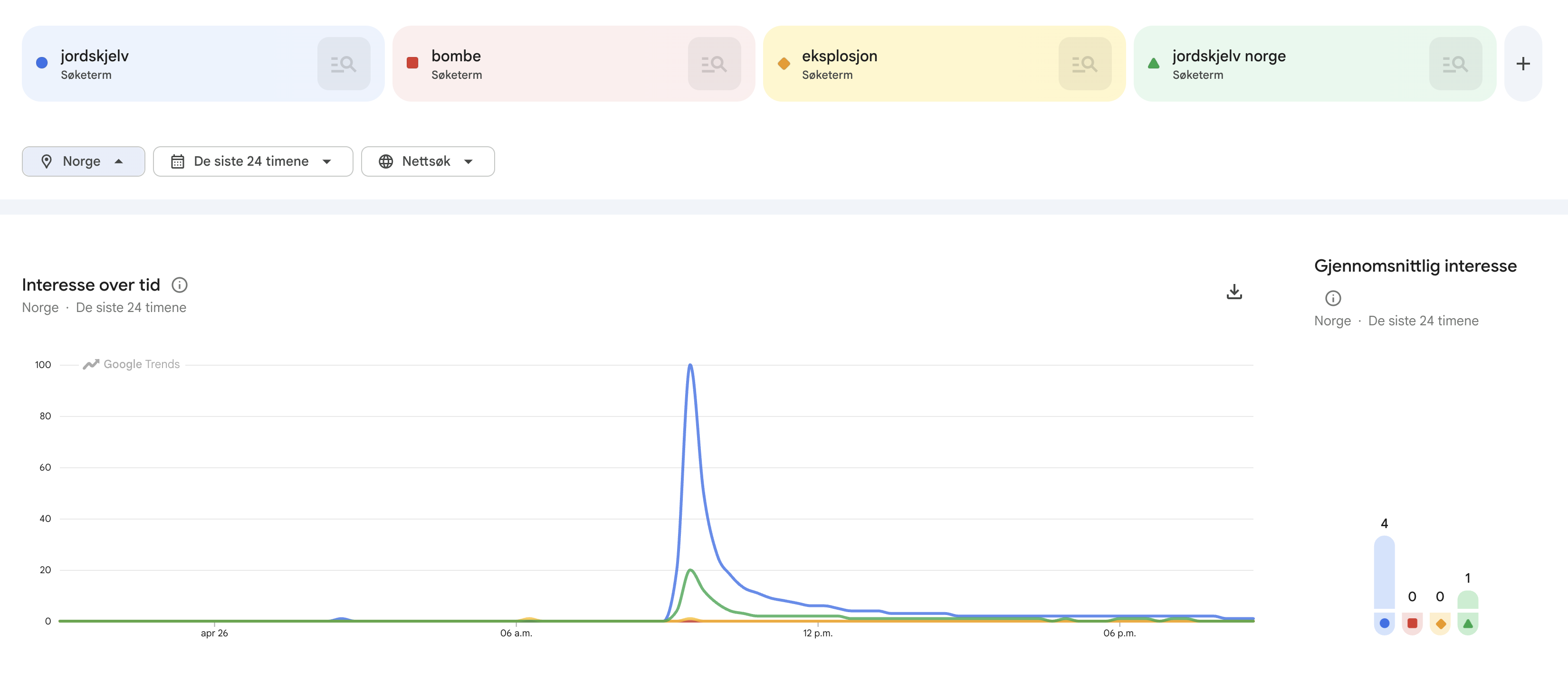
That does not mean nobody feared something worse in the first minutes. It does suggest something more interesting: once people reached for search, public interpretation converged very quickly on the correct frame.
That matters because it shows how modern events are explained in layers. The police had to keep several possibilities open in the first phase, which is exactly what they should do under uncertainty. But the public search layer was doing something different. It was not handling operational ambiguity. It was answering a simpler question: what was that? And very quickly, the answer that won was earthquake.
In a modern city, public understanding is no longer produced by one institution alone. It emerges across multiple systems at once: sensors detect, authorities assess, media distribute, and search helps the population stabilize its own interpretation.
Emergency Alert was probably not the right tool. That does not mean the architecture is complete.
It is worth saying clearly that Emergency Alert was probably not the right tool here. The system is intended for acute and serious incidents that threaten life and health, and it is delivered by police or the Civil Defence through cell broadcast in a defined area. A moderate earthquake with no known immediate threat to life likely did not cross that threshold. See About Emergency Alert and How the Emergency Alert System works.
That seems reasonable.
But the fact that Emergency Alert was probably not appropriate does not mean the surrounding architecture is complete. What today exposed is a weak middle layer between no official alert and full emergency warning.
In that gap, people do what people always do under uncertainty. They call. They search. They refresh. They speculate. They overload exactly the systems they most need to work.
Today, that middle layer was carried by a mixture of the police log, NORSAR, Norwegian media, search behavior and public improvisation. That is not failure. In fact, it worked better than many systems do. But it still feels more stitched together than deliberately designed.
Not every earthquake needs a cell broadcast.
But many events like this deserve a better status layer.
Oslo is not a high-seismicity city. It is a dependency-heavy one.
It is tempting to wave away today’s event by saying that Norway is not California.
That is true, and not especially useful.
The more relevant point is that Oslo is not seismically dead. The region lies in the Oslo Rift, an old faulted geological structure where stresses can still be released along inherited zones of weakness. NORSAR points to the 1904 Oslofjord earthquake, estimated at magnitude 5.4, as the historical reminder that the wider region is capable of more than people usually assume. See Jordskjelvet i Oslo i 1904 and From Western Norway to Andøya: When Earthquakes Are Felt in Norway.
That is the deeper point. Oslo does not sit on a global seismic hotspot, but it does sit on old broken ground.
Retired earthquake professor Conrad D. Lindholm put it plainly in TV 2’s coverage: “If it strikes unfavourably, the Oslo area has enormous destructive potential. That is the sad reality.” He adds that the Oslo field is an old rupture zone with many faults — weakness zones where the crust is thinner — and that this is exactly why earthquake risk has to be taken seriously when designing new buildings and industrial areas.
That is the right way to think about Oslo. The probability of a major event may be low, but the city is dense, technically layered and heavily dependent on systems that do not need to collapse physically before they become operationally uncertain.
A building can be structurally fine and still operationally uncertain. A mobile network can remain up and still become stressed by simultaneous demand. A city can avoid disaster and still get a live rehearsal in how fragile its confidence layer really is.
In 1904, people ran into the streets. Today, uncertainty runs through systems.
One reason today’s earthquake feels worth writing about is that it casts a strange light backward.
A historical account reproduced by Moss Avis describes the 1904 earthquake in physical, almost theatrical terms: people rushing into the streets, churchgoers fearing the vault might collapse, buildings and towers seeming to sway. In that world, uncertainty moved through bodies, buildings and the street itself.
Today, the instinct is still the same, but the infrastructure of reassurance has changed.
Now uncertainty runs through layers: sensors, seismologists, emergency lines, police operations rooms, media alerts, search engines, transport systems and public status channels. The city still looks for reassurance. It just does so through infrastructure.
That may be the real lesson from today.
In 1904, people ran outside when the ground stopped making sense. In 2026, they reach for systems for the same reason.
Closing
Today’s earthquake in Norway did not prove that Oslo is fragile in a cinematic sense.
It proved something more relevant.
A modern city can be physically intact and still operationally stressed. It can remain standing and still become uncertain. It can avoid disaster and still reveal a weak handoff between detection, public understanding and trusted coordination.
That is why I do not think today was “nothing.”
It was a reminder that infrastructure is not only concrete, steel and code. It is also timing, clarity and the speed with which a city can explain itself to itself when something unexpected happens.
Sources
- Politiloggen: Øst politidistrikt, earthquake updates
- jordskjelv.no: Jordskjelv i Oslo området
- jordskjelv.no: Jordskjelvet i Oslo i 1904
- NORSAR: Norwegian National Seismic Network
- NORSAR: From Western Norway to Andøya — when earthquakes are felt in Norway
- About Emergency Alert
- How the Emergency Alert System works
- Michigan Tech / UPSeis: How do we measure earthquake magnitude?
- TV 2: Skrekkscenarioet for jordskjelv – Oslo er veldig utsatt
- Moss Avis: «At Moss ligger utsatt til, er helt sikkert»
- Nettavisen: Politiet fryktet bombe i Oslo da jordskjelvet inntraff