Norway waited 28 years to return to the World Cup.
Naturally, we responded with moderation, dignity and a calm sense of national proportion.
This lasted approximately four minutes.
Then thousands of Norwegians gathered outside the Royal Palace in Oslo and sat down to row.
According to widely shared crowd estimates in Norwegian media and on social media, more than 15,000 people joined the Viking Row in front of the palace.
His Majesty, regrettably, was not visible. This did not stop the crowd.
Norway had not come to negotiate. Norway had come to row.
By now, the world has discovered the Viking Row: Norwegians sitting down, pulling imaginary oars and shouting “ro ro ro” — Norwegian for “row” — as if the national team had qualified for the knockout stage by crossing the Atlantic in a longboat.
It has appeared in stadiums, on escalators, in the New York subway, in Times Square and, naturally, among Norwegian politicians.
The neighbours have noticed.
Swedish media, with admirable Scandinavian calm, have observed that everyone in Norway rows.
Almost everyone.
One Norwegian supporter became a minor Nordic folk hero by refusing to join in, reportedly calling the rowing a stupid idea and arguing that Vikings should have been sailing, not rowing.
This is the kind of historical accuracy we expect from Sweden during moments of Norwegian joy.
Denmark, meanwhile, appears to be processing something more serious: the realisation that Norway may currently have both the better football team and the more irritating celebration.
But then Norway added a new layer to football analytics.
Not possession.
Not expected goals.
Seismology (!)
During Norway’s World Cup win over Iraq, the seismometer at the University of Bergen registered clear signals from supporter celebrations in Bergen. According to Jordskjelv.no / NORSAR, the largest spikes coincided with Erling Braut Haaland’s goals.
Then it happened again.
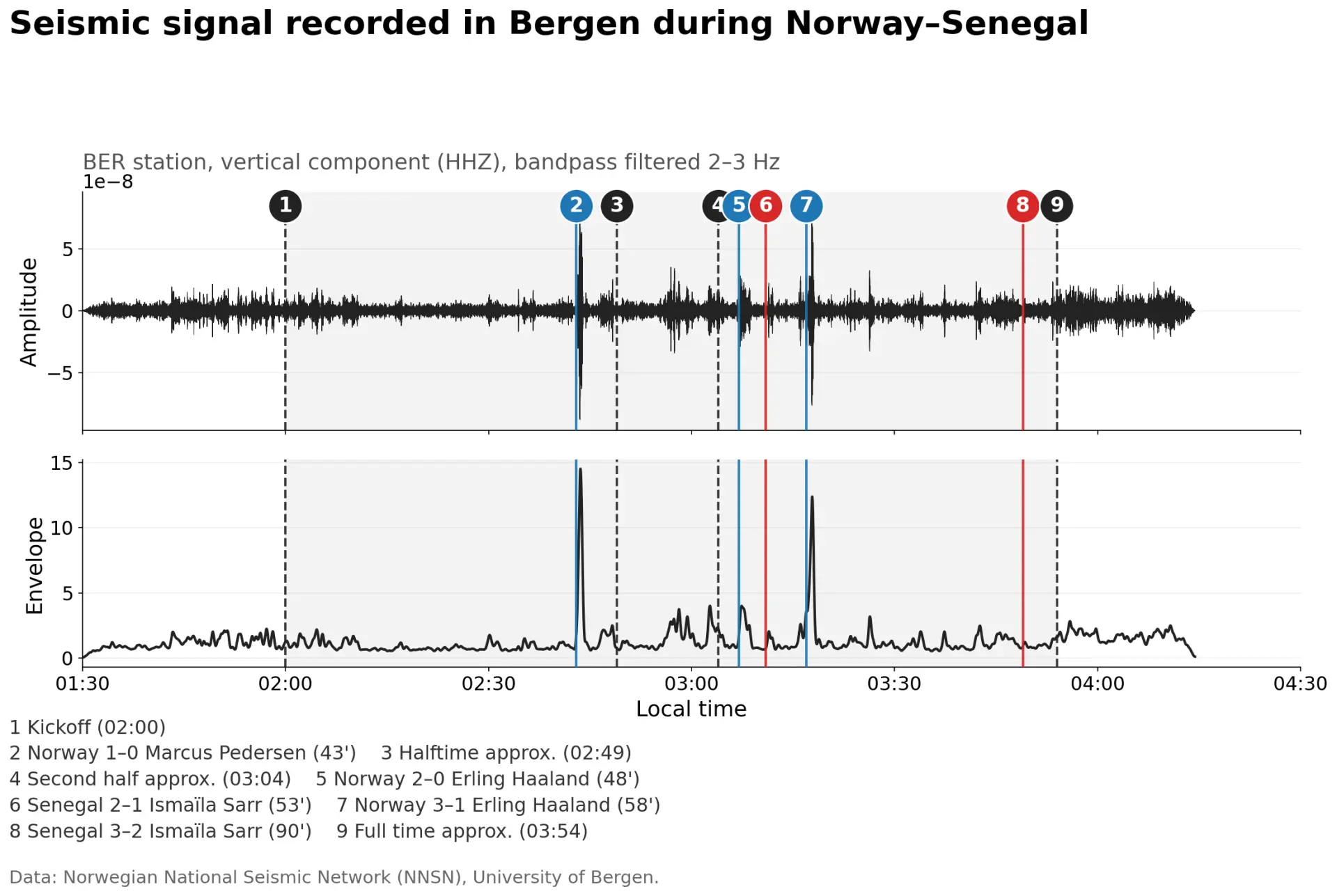
During Norway’s 3–2 win over Senegal, several of the clearest seismic signals coincided with Norwegian goals. The marked peaks were especially visible around the goals by Marcus Pedersen and Haaland.
Jordskjelv.no put it best: fortunately, it was not an earthquake keeping the seismologists awake that night. It was a “sports quake” — triggered by Norwegian goals, football drama and cheering supporters in Bergen.
This is not a metaphor - Norwegian football joy has now entered the measurable physical world. There are many ways to track a country’s return to the World Cup.
Goals. Points. Chants. Viral videos. Palace gatherings. Swedish irritation. Danish discomfort.
Next up, Norway face Côte d’Ivoire — often called Ivory Coast in English — in the World Cup Round of 32 at Dallas Stadium on 30 June. It remains to be seen whether Bergen’s seismometers will have another busy evening.
Norway has added another metric:
Richter-adjacent happiness. So, lets RO, RO, RO!
Sources / further reading
- Jordskjelv.no / NORSAR: “Haalands scoring fikk Bergen til å riste”
- Jordskjelv.no / NORSAR: “Norges VM-drama mot Senegal satte spor i bakken”
- Reuters: “Norwegian fans take dawn World Cup party to palace gates to wake the King”
- Reuters: “Norway’s ‘Viking row’ World Cup celebration irks Scandinavian neighbours”
- Reuters: “Norwegian parliament gets behind World Cup team with fans’ Viking rowing display”
- Reuters: “No regrets for no-row Norway fan caught sitting still on TV”
- ABC News / Yahoo: “Norway fans’ Viking row celebration takes over World Cup stadiums and cities”