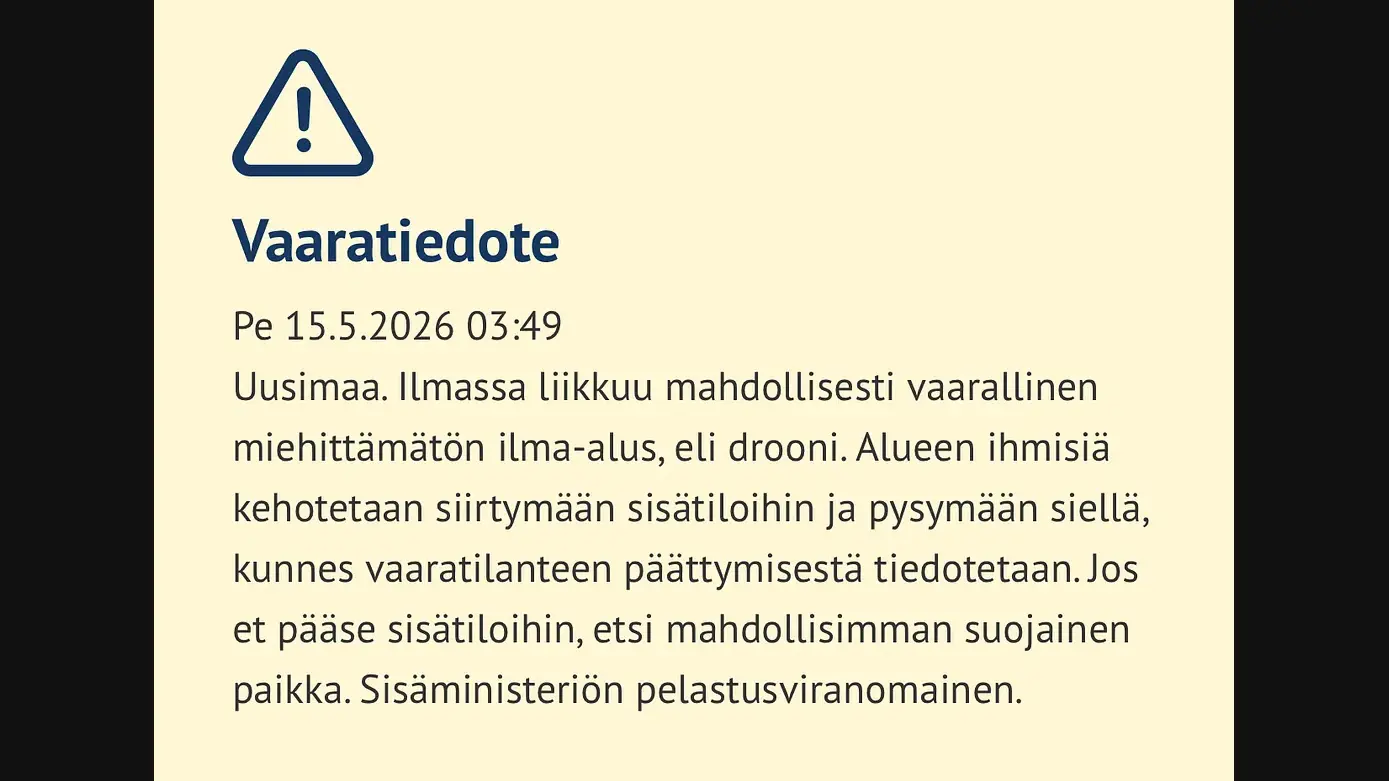
Live updates on the Uusimaa drone alert: Yle is running a continuously updated liveblog at yle.fi/a/74-20226061. The situation in this article reflects information available at time of writing.
Note: Information during fast-moving security incidents can change rapidly. Several operational details remained unconfirmed at the time of publication.
At 03:49 local Finnish time on the morning of 15 May (00:49 UTC), Finnish emergency services issued a large-scale public 112 warning across Uusimaa, the region containing Helsinki, instructing roughly 1.7 million residents to move indoors, stay away from windows, and refrain from approaching any drone debris that might be found.
Less than two hours earlier, at around 02:00 local Latvian time, the Latvian Ministry of Defence had issued a parallel warning covering the eastern border districts of Balvi, Ludza, Krāslava and Rēzekne. NATO fighters were scrambled. Finnish Hornets were airborne over Uusimaa before dawn. Helsinki-Vantaa airport was temporarily closed and inbound flights were diverted to Rovaniemi, Stockholm Arlanda and Tallinn. The all-clear came around 07:11 local time — more than three hours after the public alert. The airport reopened shortly afterwards.
Rarely have Finland and Latvia issued parallel overnight public airspace alerts affecting capital regions and eastern security zones within hours of each other. And it is genuinely uncommon, in modern Nordic peacetime, for a country's emergency notification system to push civilians into shelter at the same time a major capital airport halts traffic and NATO fighters are airborne. Until recently, each of those three responses would have been a story on its own.
Inside the alert window
Finnish authorities have not released confirmed visual sightings of the unidentified aircraft. What they did release tells the story in a different register.
The instructions issued to Uusimaa were unusually concrete: stay indoors, stay away from windows, and do not approach any fallen drone debris. The expected target zone was identified as the area between Helsinki and Porvoo. Police confirmed that observations of uncrewed aircraft had been received in southern Finnish airspace.
For more than three hours, one of Europe's busiest northern hubs operated as if a foreign object might fall from the sky at any moment. Helsinki-Vantaa, which handles tens of thousands of passengers on a normal Friday, simply stopped. Aircraft already inbound were redirected mid-flight: short-haul to Tallinn and Stockholm Arlanda, longer routes north to Rovaniemi.
The Latvian alert ran on a parallel clock across four eastern districts.
As of the all-clear shortly after 07:00 local time, no physical contact had been confirmed in either country. The Defence Forces stated that Finland faces no direct military threat. That is a narrow operational statement. It does not address what comes next.
A timeline that no longer reads as coincidence
Each incident below has been treated, individually, as an isolated case. Read together, they describe a different shape.
| When | Event |
|---|---|
| 15 May 2026 — ~07:11 EEST (~06:11 CEST) | All-clear declared in Finland and Latvia. Helsinki-Vantaa reopens shortly afterwards. No confirmed physical contact in either country. |
| 15 May 2026 — early morning | Finnish Hornets airborne over Uusimaa. Helsinki-Vantaa halted; inbound flights diverted to Rovaniemi, Stockholm Arlanda and Tallinn. |
| 15 May 2026 — 03:49 EEST (02:49 CEST; 00:49 UTC) | Finland issues 112 public shelter warning across Uusimaa: stay indoors, away from windows, do not approach drone debris. |
| 15 May 2026 — ~02:00 EEST (~01:00 CEST; 23:00 UTC, 14 May) | Latvia issues overnight airspace alert across Balvi, Ludza, Krāslava and Rēzekne. NATO fighters scrambled. |
| Throughout 2026 | Norway's Armed Forces Operational Headquarters confirms increased Russian military flight activity over the Norwegian Sea. Norwegian fighters at Evenes scrambled at a pace already comparable to all of 2025. |
| Early May 2026 | Unidentified drones observed near the Finnish-Russian border. |
| Late March 2026 | Ukrainian drones reportedly crash near Kouvola, Finland. |
| Early 2025 | Renewed cable incidents affect C-Lion1 and infrastructure connecting Sweden and Latvia. |
| 25 December 2024 | EstLink 2 power cable between Finland and Estonia damaged. Finnish authorities seize the tanker Eagle S, associated with Russia's so-called shadow fleet. |
| November 2024 | Two fibre-optic cables, including C-Lion1 between Finland and Germany, severed within a short time window. |
| October 2023 | Balticconnector gas pipeline and parallel telecommunications cables between Finland and Estonia damaged by anchor drag involving the Chinese-flagged vessel Newnew Polar Bear. |
The pattern, not only the incident
Finnish authorities stated publicly that Finland faces no immediate direct military threat. That assessment may well be correct in the narrow operational sense.
But the broader regional pattern is becoming harder to dismiss as isolated overspill.
What initially appeared to be temporary spillover from a distant war increasingly resembles a steady-state security condition across the Nordic-Baltic eastern flank.
And the pattern is not only above the water
The seabed has reflected many of the same tensions for more than two years. I wrote last autumn about Norway's own fragile digital connections — a small number of subsea cables carrying a disproportionate share of the country's traffic. The Finnish and Estonian incidents repeat the same structural pattern with different geography.
Attribution in each case has rightly been cautious and evidence-driven. But the aggregate pattern itself is no longer seriously disputed: the same stretch of sea that acts as the digital lifeline between the Nordics and continental Europe has experienced a sustained sequence of infrastructure incidents involving vessels later linked through ownership structures, routing history or operational proximity to Russian or Chinese interests.
Last night's airspace alerts feel like the same story moving one layer higher in the infrastructure stack: from seabed to sky.
European critical infrastructure is no longer separable
I run a cloud infrastructure company. I think about resilience and operational dependency every day.
That is why last night's alerts matter beyond the immediate safety implications.
Airspace is only the visible layer of a much larger infrastructure fabric — and much of that fabric is now digital.
Within a matter of hours, the overnight alerts affected:
- Civil aviation and airport operations
- Cross-border logistics and rerouting
- Emergency telecommunications and public warning systems
- Public-service broadcasting
- NATO and regional air defence coordination
Every one of those systems depends heavily on digital infrastructure. And across much of Europe, a substantial share of that infrastructure increasingly depends on US-controlled hyperscale cloud platforms and globally interconnected identity systems.
Email. Authentication. File storage. Video meetings. Operational dashboards. AI systems. Emergency coordination tools.
Technically, the hyperscalers are exceptionally capable. This is not an argument that they are insecure.
It is an argument that resilience requires operational independence from single points of failure.
And the most overlooked single point of failure in European infrastructure today may not be physical airspace at all — but the assumption that the digital substrate will continue functioning seamlessly at the precise moment the physical one becomes unstable.
Sovereignty is no longer theoretical
For years, discussions about European digital sovereignty largely lived inside policy papers and conference panels.
CLOUD Act. Schrems II. GDPR. EUCS.
Important discussions, but abstract enough that many operational teams could postpone dealing with them.
Events like last night's alerts make the issue operationally concrete.
When emergency notifications are issued in the middle of the night and airports begin shutting down before dawn, there is no time to discover that:
- authentication depends on infrastructure outside Europe,
- incident coordination tools require third-country identity providers,
- or critical operational systems cannot function independently during degraded connectivity conditions.
This is not about isolationism. It is about continuity planning.
What Nordic operators should ask themselves today
Three questions now matter far more than they did a few years ago:
- If our authentication provider becomes unreachable for six hours, can operations teams still access the systems required to manage an incident?
- If geopolitical or connectivity disruptions affect a cloud region, do we have a continuity path that does not require emergency procurement and migration projects?
- At the operational level — not the marketing level — do we actually know where customer data, backups and identity systems physically reside?
If the answers are unclear, the overnight alerts in Finland and Latvia should probably change this week's priorities.
The Nordic case
The Nordics are unusually well positioned for this discussion.
Cold climate for efficient cooling. Abundant hydroelectric energy. Dense fibre infrastructure. Stable regulatory environments. Strong engineering competence. And increasingly, political willingness to invest in resilient regional alternatives.
Finland's proximity to contested airspace is not new. Neither is the Baltic Sea's strategic importance. But the combination of repeated airspace alerts, seabed infrastructure incidents and rising geopolitical friction changes the operational conversation.
The correct response is neither panic nor business-as-usual procurement. It is to recognise that digital infrastructure is now inseparable from national resilience — and to design accordingly.
Whether the specific threat last night ultimately proves substantial or limited, the broader regional pattern no longer appears temporary.
Sources
Live updates and public warnings (15 May 2026)
- Yle liveblog: yle.fi/a/74-20226061
- Yle initial alert coverage: yle.fi/a/74-20226058
- Yle shelter guidance: yle.fi/a/74-20226062
- Finnish emergency notification portal: 112.fi/etusivu
- VG coverage of Finnish and Latvian alerts: vg.no
- LSM English reporting: eng.lsm.lv
- Latvian Ministry of Defence public statements
Previous regional incidents and infrastructure events
- Balticconnector incident reporting (2023)
- C-Lion1 and Baltic cable reporting (2024–2025)
- EstLink 2 reporting and Eagle S investigation
- Reuters, NPR, Al Jazeera and VOA reporting archives
- Cinia infrastructure information: cinia.fi
Government and defence references
- Finnish Defence Forces public statements
- Norwegian Armed Forces Operational Headquarters via VG reporting
- Latvian Ministry of Defence statements